When a custom soccer ball order disappoints, the artwork is almost never the culprit. The logo prints fine. What goes wrong sits underneath the design: a bladder that cannot hold air on a shelf, a cover chosen on price that cracks in the cold, a ball ordered off official dimensions, or a panel layout that fights the print. These are spec decisions, and they are easy to get right once you know what each one controls. Here are the mistakes buyers make most, and how to avoid them.
Buying for the wrong use
The first mistake is treating a soccer ball as one product when it is really three. A match ball is built to perform and certify, a training ball is built to survive daily abuse, and a promotional or gift ball is built to look good and hit a price. Order a thin promo ball for a club’s training sessions and it will not last a season; order a premium match ball for a giveaway and you have overspent by a wide margin. Decide the real use first, because it dictates every other spec below, from the cover material to the number of backing layers laminated under it. Matching the ball to the job is the single decision that prevents the most expensive regrets.
Ignoring the bladder
The bladder is the part buyers forget and then blame. It is the internal air chamber, and its material decides how long the ball stays inflated. A latex bladder gives the softest, liveliest touch, which is why professional match balls use it, but it is porous enough that the ball noticeably softens after just one or two days and needs regular re-pumping. A butyl bladder trades a little of that feel for dramatically better air retention, holding pressure for weeks or even months. Synthetic rubber sits in between.
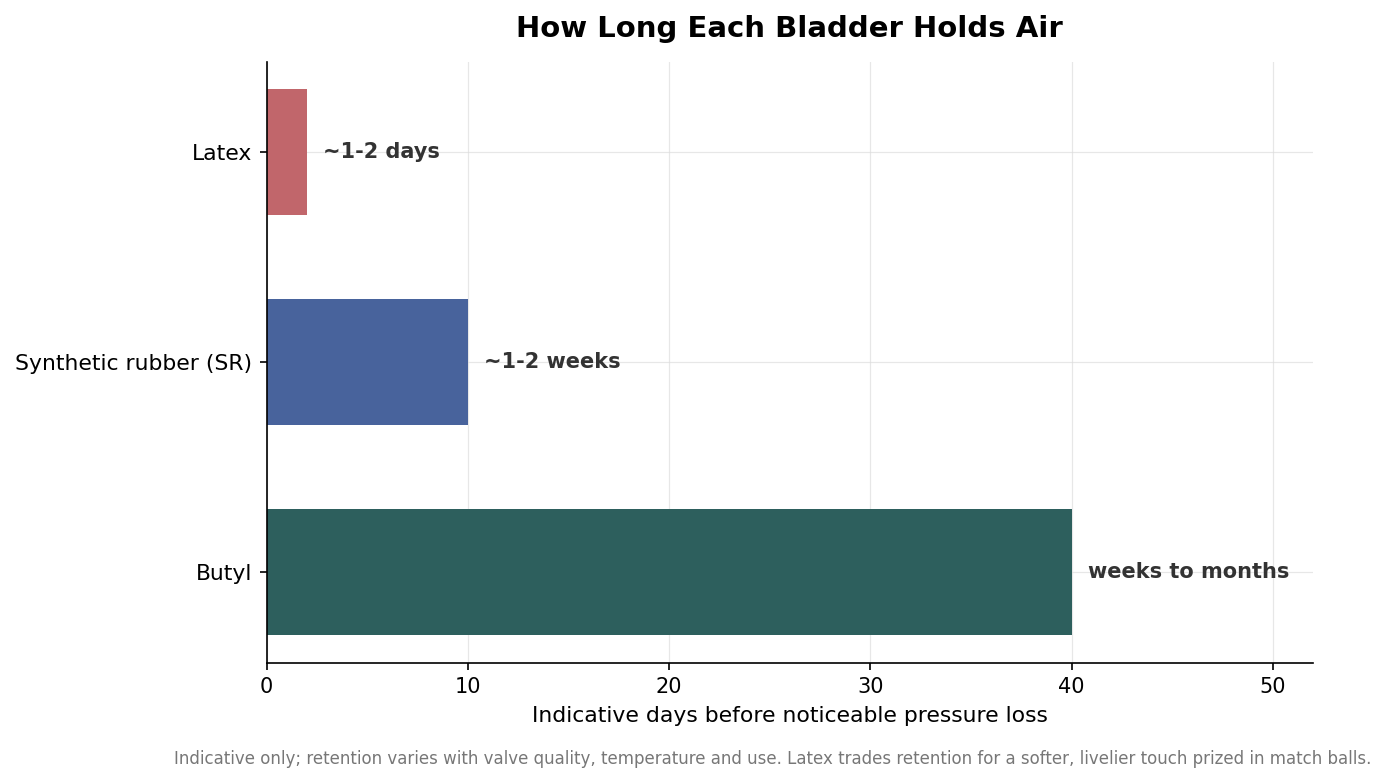
The reason this matters for custom orders is shelf life. A promotional ball that sits in a box for a month before an event should almost always be butyl, because a latex promo ball will arrive flat and read as cheap no matter how good the print looks. Reserve latex for balls that will be inflated and played immediately by people who value the touch. Getting this one wrong is why so many giveaway balls disappoint on arrival.
Choosing the cover on price alone
The cover is the outer surface, and its material is a genuine cost-versus-durability tradeoff rather than a simple better-or-worse choice. PVC is the budget option: inexpensive and serviceable, but harder to the touch and prone to stiffening and cracking in cold weather, which makes it best for promotional and gift balls that will not see hard year-round play. PU is the premium surface, softer and more responsive with better wear resistance, and it is what match and serious club-training balls use. TPU lands in the middle, offering much of PU’s durability and cold tolerance at a lower price, which makes it a strong pick for training and junior match balls.
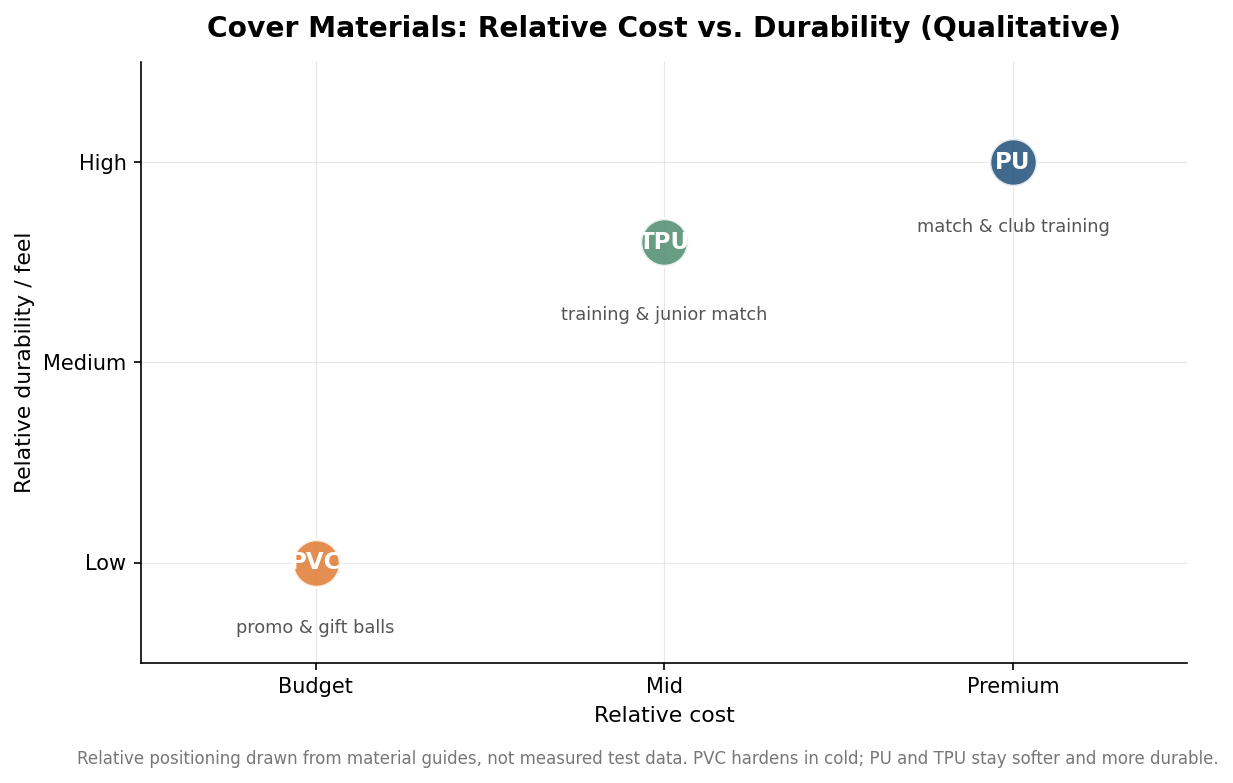
The mistake is defaulting to PVC to hit a headline price without asking where and when the ball will be used. If it is a winter club or an outdoor program, PVC’s cold-weather stiffness will show quickly, and the small savings per ball turn into replacements. If it is a summer handout, PVC is perfectly reasonable. Spend where the use demands it and save where it does not.
Ordering off official spec
A custom ball meant for actual play has dimensions it must meet, and skipping them produces a ball that looks right but plays wrong. A regulation size 5 ball, the adult standard, measures 68 to 70 centimeters in circumference, about 27 to 28 inches, weighs 410 to 450 grams or roughly 14 to 16 ounces, and inflates to between 0.6 and 1.1 atmospheres, which is about 8.5 to 16 psi. Youth sizes step down from there, with size 4 and size 3 for younger age groups. Some very cheap promotional balls quietly come in under weight or under size; that is fine for a display piece but disqualifying for anything that will be kicked competitively. Confirm the finished size and weight in the spec, not just the diameter of the artwork template, and match the size to the age group that will actually use it.
Designing artwork without the panels in mind
The last common mistake is designing the graphic as if the ball were a smooth sphere. It is not; it is an assembly of panels, and how those panels are cut and joined shapes what the print can do. A traditional 32-panel stitched ball has visible seams that run through any large logo or photo, so fine detail and continuous background art can break across the stitching. Modern thermally bonded balls with fewer, larger panels present a smoother, more continuous surface that flatters full-coverage designs, though they usually carry higher minimums and cost. Print method matters too: sublimation lays full-color art into the panel before assembly and holds up well, while surface printing can wear at high-contact areas. The fix is simple but easy to skip: design to the actual panel layout and print process your ball uses, keep critical elements clear of seams, and ask for a panel-accurate proof rather than a flat mockup before you approve the run. Taken together, these five checks cost nothing to run through before you order, and each one closes off a failure that only shows up after the balls arrive, when it is too late and too expensive to fix.