Ordering custom soccer balls means choosing a tier before you choose a design. The same logo can go on a giveaway ball that costs a few dollars or a match ball that costs thirty times as much, and the two are not interchangeable. A ball built to be handed out at a sponsor booth will disappoint a club that wanted training gear, and a hand-stitched match ball is money wasted if it spends its life in a giveaway bin. This guide walks through the three tiers most custom programs choose among, what actually differs between them, and how to match the tier to the job before you approve artwork.
What separates the three tiers
Promotional balls are built around the print, not the play. They usually carry a PVC or thick TPU cover on a machine-stitched 32-panel body, prioritizing a smooth, uniform surface for logos and a low unit cost over touch and flight. They will kick around a backyard fine, but they feel firm and are not meant for organized play. Training balls step up to a tougher TPU or PU cover, still machine-stitched, with reinforced backing layers that survive daily drills on rough fields. Match balls use premium polyurethane covers that are hand-stitched or thermally bonded into a seamless surface, with water-resistant coatings and the tighter weight and roundness tolerances that sanctioned play demands. As you climb the tiers you are paying for feel, flight consistency, and durability under real use, in that order.
Construction is where the tiers physically diverge. Machine stitching is fast and economical and holds up well, which is why it dominates promotional and training balls. Thermal bonding fuses panels without stitch holes, reducing water uptake and giving a truer surface, which is why it shows up on match balls and why those balls cost what they do. If a supplier quotes a “match ball” price that looks like a training ball, ask how the panels are joined before you assume you are getting match-ball performance.
The bladder is the part buyers overlook
Inside every ball is a bladder, and it drives two things buyers care about: how often the ball needs pumping and how lively it feels. Butyl bladders have very low gas permeability, so they hold pressure for a long time and suit schools, rec programs, and training stockpiles where nobody wants to reinflate a bin of balls every week. The tradeoff is a slightly damped, firmer response. Latex bladders flip that: they offer more elastic, explosive rebound and the softer touch players prize, but they lose air faster and need topping up before most sessions. Synthetic rubber sits in the middle, which is why it is common on balls that serve double duty for training and occasional matches.
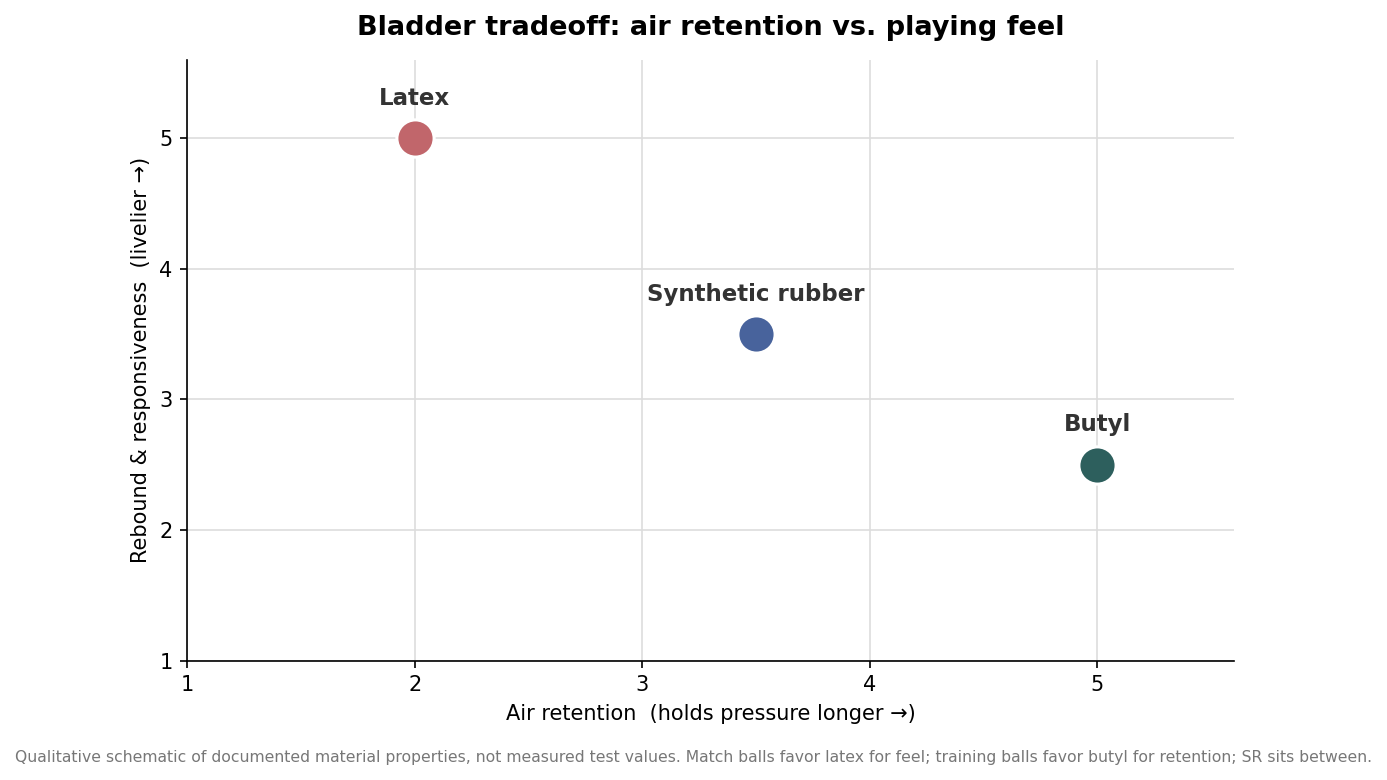
The practical read on that tradeoff is simple. If the balls will be inflated and checked before every use by a coach or referee, latex rewards you with better feel, which is exactly why match balls use it. If the balls live in a closet or a school cart and get grabbed on the way to the field, butyl saves you the constant pumping. Ask which bladder a quoted ball uses; it tells you more about day-to-day experience than the marketing name on the box.
What each tier costs, and where the money goes
Single-ball retail pricing gives a useful frame even when you buy in bulk. Promotional balls typically sell in a low band, training balls run roughly fifteen to fifty dollars, and match balls span fifty dollars to well past a hundred and seventy for flagship models. Your custom per-unit cost drops substantially at hundreds-plus quantities, but the tier gaps hold: a match ball will always cost multiples of a promotional ball because the cover, the stitching or bonding, and the tolerances cost more to produce.
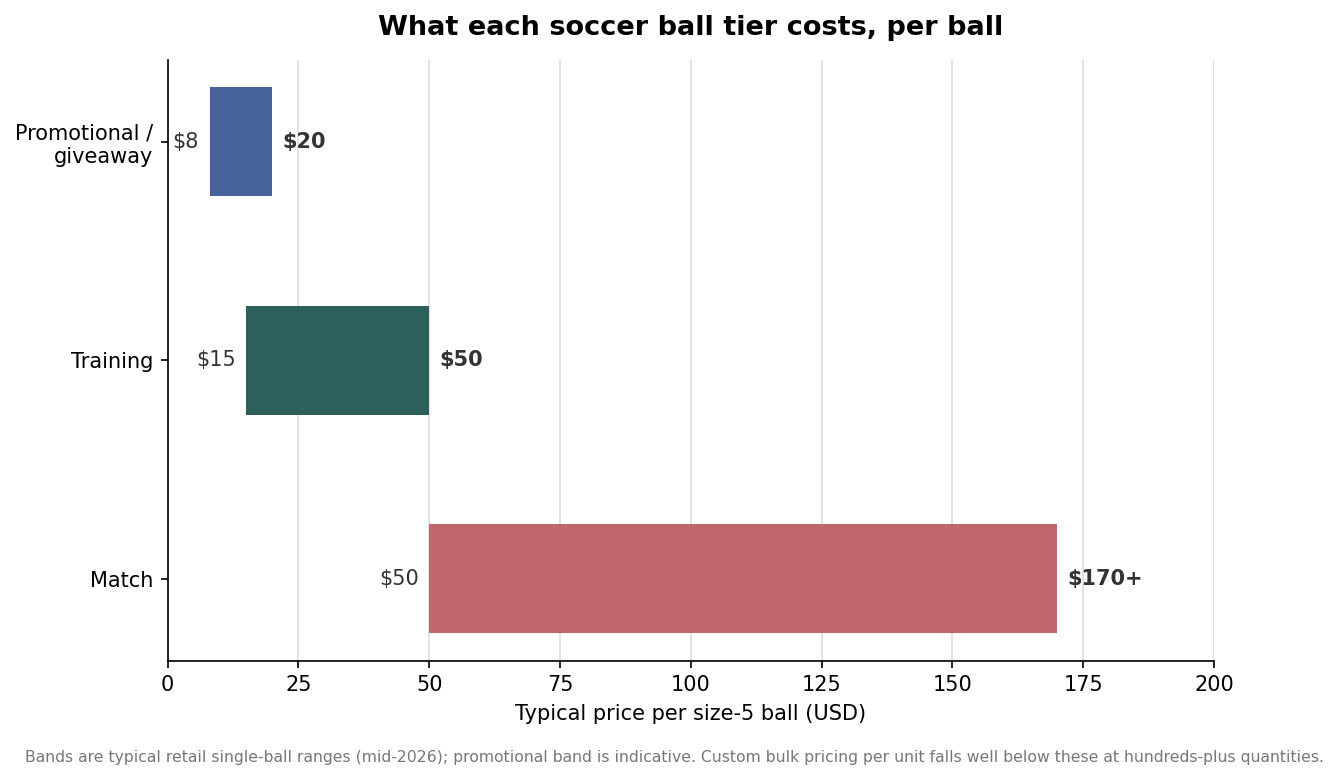
Read the bands as a budgeting tool rather than a target. A youth club outfitting twenty teams with training balls is solving a very different math problem than a business ordering five hundred branded giveaways, and the right answer is rarely the most expensive ball you can afford. Overspending on match balls for casual use wastes money on performance nobody will notice; underspending on promotional balls for a competitive program buys gear that gets retired fast. Anchor the budget to how the balls will actually be used.
Matching the tier to the job
For giveaways, sponsorships, and brand awareness, the promotional ball is the correct choice precisely because it is cheap and prints cleanly. Nobody expects a trade-show ball to fly like a match ball, and spending up would only shrink the quantity you can hand out. For club and school training, the training ball is the workhorse: durable enough for daily abuse, forgiving on the budget across dozens of balls, and honest about its job. For match day, tryouts, and showcase events, the match ball earns its price through consistent flight and the certified weight and roundness that sanctioned games require. Many programs buy two tiers at once, training balls in volume and a smaller set of match balls for games, which is usually smarter than forcing one tier to do everything.
Where certification matters, be specific. A size-5 ball for sanctioned play must fall within the governing-body window of roughly 68 to 70 centimeters in circumference, 410 to 450 grams in weight, and an inflation pressure near 0.6 to 1.1 atmospheres, and league play often requires a recognized quality mark. Promotional and training balls carry no such approval and should not be ordered for officiated matches. If your program plays sanctioned games, confirm the mark on the specific model, not the product line.
Specifying a custom print without downgrading the ball
Customization should ride on top of the tier you chose, not force a lower one. Full-surface sublimation and panel printing are available across tiers, but the process interacts with construction: bonded match balls take edge-to-edge graphics beautifully, while heavily stitched promotional balls print cleanly on panels with a little design allowance around the seams. Supply vector artwork, confirm the number of print colors or whether the design is full-color sublimated, and ask for a digital proof and, ideally, a single physical sample before a large run. Approving a proof on the actual tier you intend to buy is the last checkpoint that keeps the finished balls looking and playing the way you expected when you set the budget.