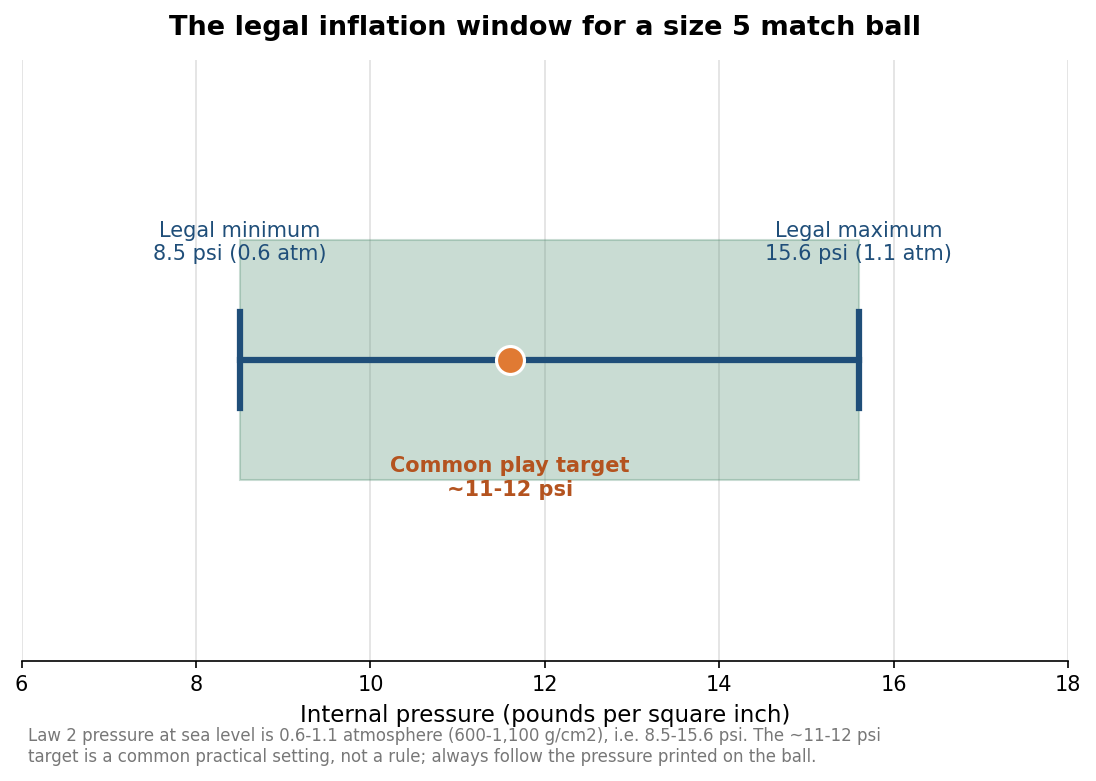
A size 5 soccer ball is legal to play with anywhere from 8.5 to 15.6 pounds per square inch, and most balls play best somewhere in the middle of that band, around 11 to 12 psi. That single range answers the question most people arrive with, but it hides a few things worth understanding if you are buying, branding, or simply trying to keep a ball feeling right: where the number comes from, what happens when you stray from it, how to inflate without wrecking the valve, and why two balls at the same pressure can lose their air at very different rates.
What the official spec actually says
The pressure figure is set by Law 2 of the Laws of the Game, which defines every dimension of a match ball. A size 5 ball must be spherical, made of a suitable material, with a circumference between 68 and 70 centimeters (27 to 28 inches) and a weight between 410 and 450 grams (14 to 16 ounces) at the start of the match. Its internal pressure at sea level must equal 0.6 to 1.1 atmosphere, which the law also expresses as 600 to 1,100 grams per square centimeter, or 8.5 to 15.6 pounds per square inch.
Those are the boundaries a referee can check, not a single target. The weight is specified at the start of play because a ball picks up water and mud during a match and drifts heavier, and the pressure is fixed at sea level because altitude changes the reading. For custom and promotional balls the same physical spec applies if you want the ball to play like a real one, which is why reputable manufacturers print a recommended pressure directly on the panel near the valve.
Which pressure to actually use
Always follow the number printed on the ball first. If the panel says inflate to 8.7 psi, that is the manufacturer’s tested setting and it takes priority over any general rule. Absent a printed figure, the safe practical target for a size 5 ball is roughly 11 to 12 psi — comfortably inside the legal window and firm enough for true flight without being rock hard.
The reason the middle of the range is the sweet spot is that both extremes cost you something. Over-inflate toward 15 psi and the ball flies faster and truer but feels harsh off the foot, bounces unpredictably high, and puts more stress on the seams and bladder, shortening its life. Under-inflate toward 8 psi and the ball feels soft and dead, deforms on contact, curves less predictably, and drags on the ground. A ball that feels slightly soft under a firm thumb press — giving perhaps a centimeter — is usually close to right, but a cheap pressure gauge removes the guesswork and costs almost nothing.
How to inflate without ruining the valve
Most air-retention problems trace back to a valve damaged during inflation, so technique matters. Use a proper ball pump with a needle sized for soccer valves, and moisten the needle with a drop of water or a little glycerine before inserting it — a dry needle drags against the rubber valve and can tear it. Insert the needle straight in, not at an angle, so it does not gouge the valve channel, and hold the ball steady while you pump.
Inflate slowly to the printed pressure and check with a gauge rather than by feel, then remove the needle gently. Avoid fully inflating a ball that is cold and stiff straight from a garage or a winter field; let it reach room temperature first, because cold rubber is less flexible and forcing air in can stress the seams. For storage, keep the ball partially inflated rather than bone hard or fully flat — a little internal pressure helps it hold its round shape without keeping the bladder and seams under constant maximum tension.
Why some balls go flat faster
Two balls inflated to the same pressure can behave completely differently over a week, and the reason is the bladder inside. A butyl bladder has an extremely tight molecular structure that holds air the longest, which is why it is the default for training and recreational balls and anywhere frequent re-inflation is impractical; the trade-off is a firmer, more controlled, slightly less lively feel. A latex bladder is the opposite: its looser structure leaks air faster and needs topping up more often, but it delivers the softest touch and the most responsive, explosive rebound, which is why premium match balls tend to use it. A synthetic rubber bladder sits in the middle, holding air better than latex while keeping a stable, consistent rebound, and it is common on school and college balls where predictability matters.
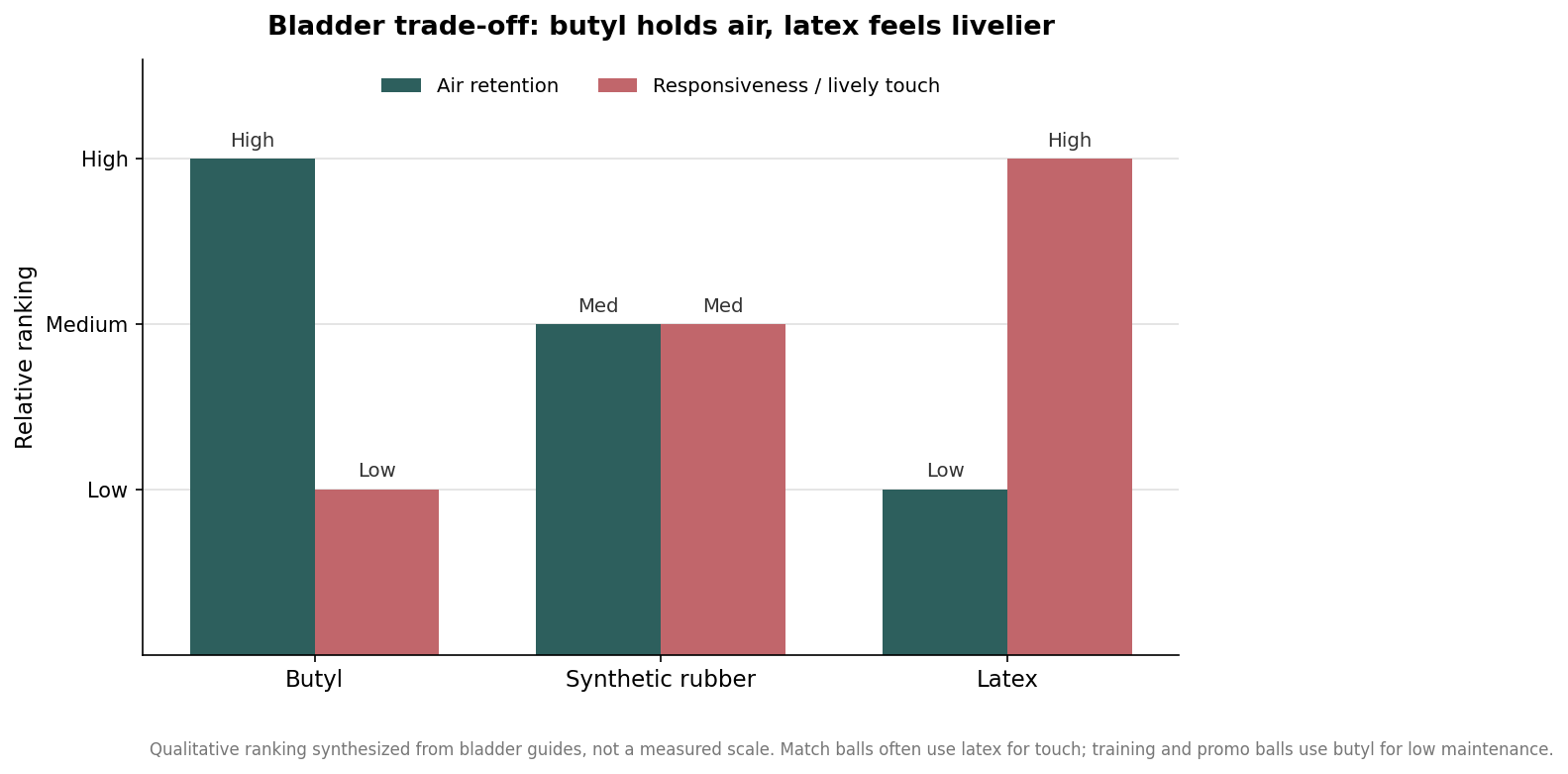
None of this changes the legal pressure — every bladder type still plays within the same 8.5 to 15.6 psi window — but it changes your maintenance. A latex match ball may want a quick check before every session; a butyl training ball might hold usable pressure for a couple of weeks. Knowing which you have sets a realistic expectation instead of a nagging sense that the ball is defective.
Matching the spec to a custom order
If you are ordering branded balls, decide first how they will be used, because that dictates the construction more than the print does. A giveaway or photo-op ball can be a simpler, lower-cost build where perfect flight is not the point; a ball meant for real training should carry a durable butyl bladder and a stitched or bonded construction rated for repeated kicking; and a ball intended for competitive play should meet the full size 5 spec above and, ideally, carry a recognized quality mark. Whatever the tier, ask for the recommended inflation pressure to be printed on the ball, and confirm the circumference and weight targets in writing. Get the specification right at the order stage and the ball will play the way people expect the moment they pump it up — which, done correctly, means to the number on the panel and no higher.