Soccer Ball Size by Age: The Complete Size Chart
Buy the wrong size soccer ball and a five-year-old ends up wrestling a ball meant for an adult, or a competitive teenager trains with one that flies too light. Size is set by the player’s age, and the system runs from a tiny skills ball up to the full-size match ball the pros use. This guide gives the age-to-size answer first, then the actual specifications behind each size, the two ages where the choice gets fuzzy, and how to pick when you are ordering a batch of balls for a team or an event.
The quick answer: size by age
Youth soccer uses three playing sizes tied to age. Size 3 is the ball for the youngest players, roughly age eight and under, the range most leagues label U8. Size 4 takes over for the middle years, about ages nine through twelve, or U9 through U12. Size 5 is the full-size official ball for players thirteen and older, which means every teenager, adult, and professional plays with the same size. Below all of that sit sizes 1 and 2, which are not really league balls at all but skills and mini balls, useful for toddlers and for footwork practice.
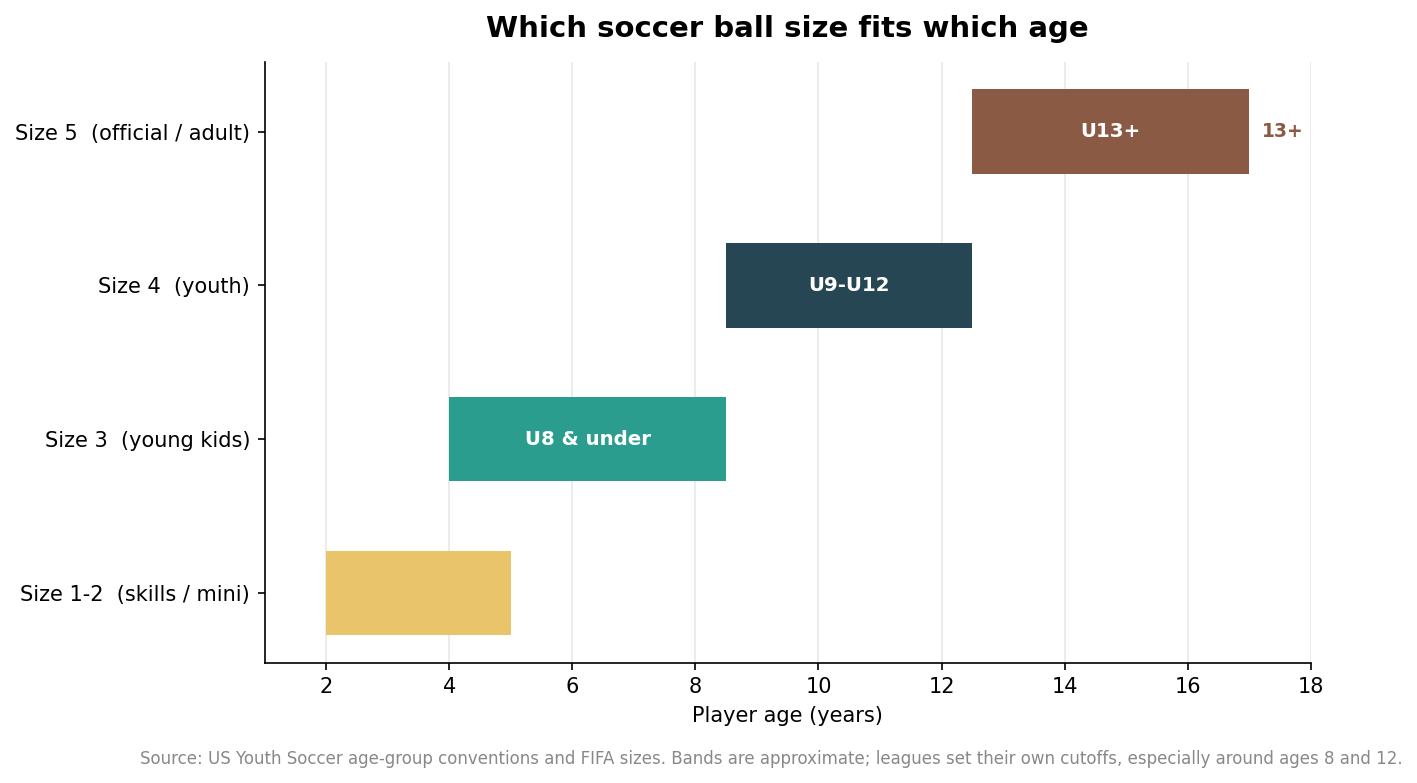
If you only remember one thing, remember the three cutoffs: three for the little ones, four for the in-between years, and five from the teens up. Those cover the vast majority of players and are the safe default when a league has not told you otherwise.
What the sizes actually mean
The size number maps to a real circumference and weight, standardized so that a size 5 from one maker matches a size 5 from another. A size 5 measures about 27 to 28 inches around, roughly 68 to 70 centimeters, and weighs between 410 and 450 grams. A size 4 is a step down at about 25 to 26 inches, 63.5 to 66 centimeters, and 350 to 390 grams. A size 3 comes in around 23 to 24 inches, 58 to 61 centimeters, and 300 to 320 grams. The smaller sizes shrink from there, with size 2 near 21 to 22 inches and around 250 grams, and size 1 a mini ball of roughly 18 to 20 inches whose weight is not tightly standardized.
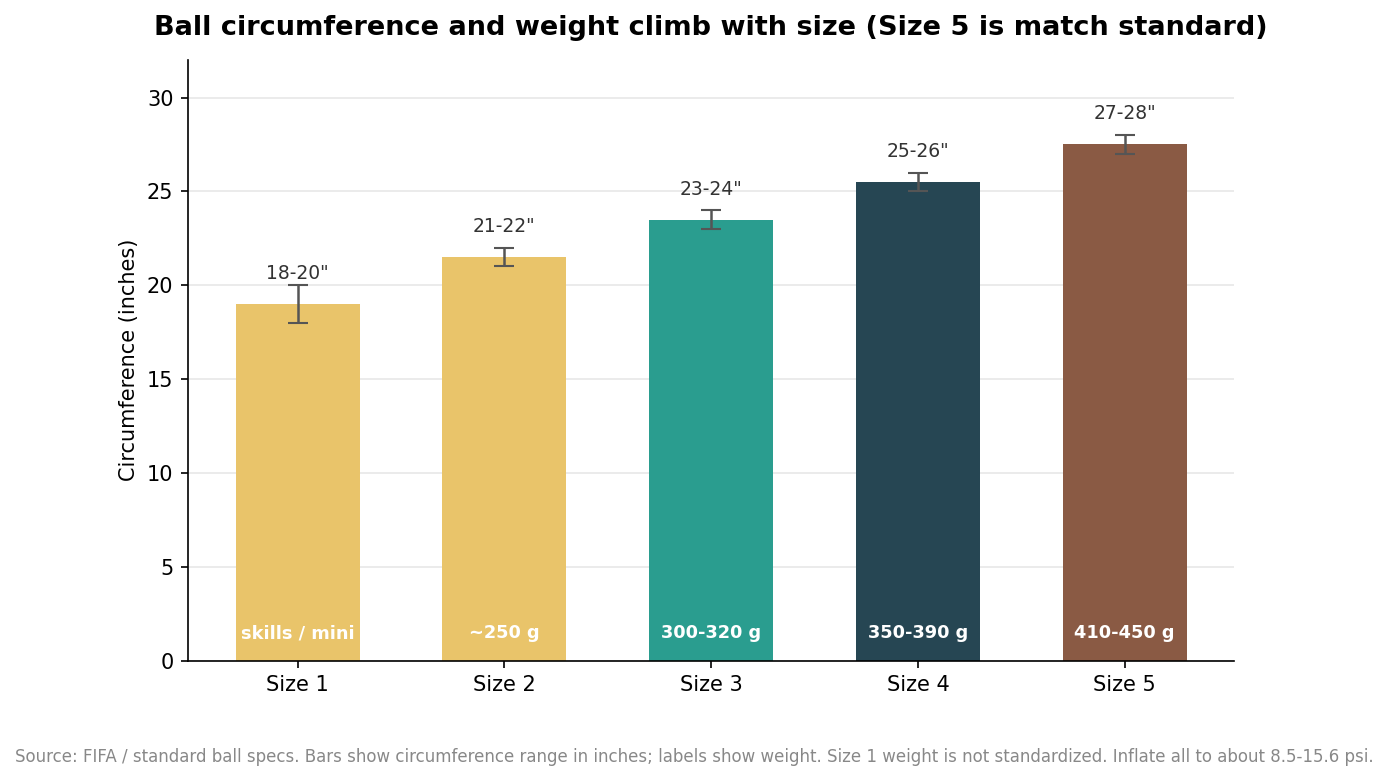
Inflation matters as much as size. A properly inflated ball of any size sits in the range of about 8.5 to 15.6 psi, following the FIFA rule that a match ball hold between 0.6 and 1.1 atmosphere at sea level. Check the pressure printed near the valve, because an underinflated ball feels heavy and dead while an overinflated one gets hard and unpredictable. A cheap pump with a gauge pays for itself the first week.
Choosing at the fuzzy edges
Two ages cause almost all the confusion: eight and twelve. Around age eight a player is sitting on the line between size 3 and size 4, and different leagues draw it differently, some moving up at eight and others holding at size 3 through the season. Around age twelve the same thing happens between size 4 and the full-size 5, with some competitive programs introducing the size 5 a year early to prepare players for the jump. The rule that beats any chart is to check the specific league’s requirements first, because a mismatched ball can be a problem at organized games. When a child is between sizes or physically small for their age, sizing down for comfort and control is usually the better call for enjoyment and skill-building, even if the calendar says otherwise.
Sizes 1 and 2: skills, minis, and giveaways
The small sizes are easy to dismiss, but they earn their place. Size 1 is a mini ball, often used for close-control footwork drills where the reduced size forces cleaner touches, and it doubles as a keepsake or collectible. Size 2 is a toddler and training ball for the youngest kids just starting to kick. Because both are compact and inexpensive to produce, they are also the go-to for promotional and event balls, the kind handed out at a tournament, a school fundraiser, or a brand activation. If your goal is a memorable giveaway rather than league play, a printed size 1 travels and displays far better than a full-size ball.
Ordering custom balls for a team or brand
When you are buying more than one ball, size selection becomes a batch decision. For a single team, order every ball in the size that matches the squad’s age group so training and warmups stay consistent, and buy a few spares because balls wander off and lose air over a season. For a club spanning several age groups, plan the split up front: a stock of size 3 for the youngest teams, size 4 for the middle, and size 5 for the oldest and any adult sides. For a promotional run tied to an event or a brand, the mini size 1 or a size 2 usually gives the best mix of visual impact, shippability, and cost per unit, while a size 5 is the right choice when the recipients will actually play with it.
Whatever the size, a custom ball is printed across its panels, so a bold, simple design with strong contrast reads better at a distance than fine detail that breaks up across the seams. Confirm the size against the intended age group before you commit the order, spell out the pressure range so recipients inflate to spec, and keep the color and logo consistent across the batch so a team or a campaign looks like a set. Get the size right and everything downstream, from how the ball plays to how it looks in a lineup, follows from that one choice.
Create your custom soccer balls now.
Send your logo, quantity and date — you’ll get a free mockup and quote today.
Get a QuoteWin Free Stuff
Enter below for a chance to win plus receive 10% off your first order.
🎉 You are in!
Check your email for your 10% off code. Good luck!