FIFA Quality Marks Explained: Basic, Quality, Quality Pro and IMS
Order a batch of custom soccer balls and you will run straight into a wall of quality marks: FIFA Basic, FIFA Quality, FIFA Quality Pro, and the older IMS stamp. They are not marketing badges. Each one maps to a defined battery of laboratory tests, and the mark a ball carries tells you what it was actually built to survive. Picking the right tier is the difference between a promotional giveaway that looks the part and a match ball a referee will accept for competitive play.
This guide explains what the marks certify, where the real gaps between tiers sit, and how to decide which grade your order needs before you approve a proof.
What the FIFA marks actually certify
A FIFA quality mark certifies performance and durability measured against a published protocol, not the look of the ball. Testing is done on production samples in accredited labs, and a ball has to clear roughly ten separate checks to earn a stamp. The headline tests cover roundness, weight, rebound consistency, water absorption, pressure retention, and shape retention after repeated impact.
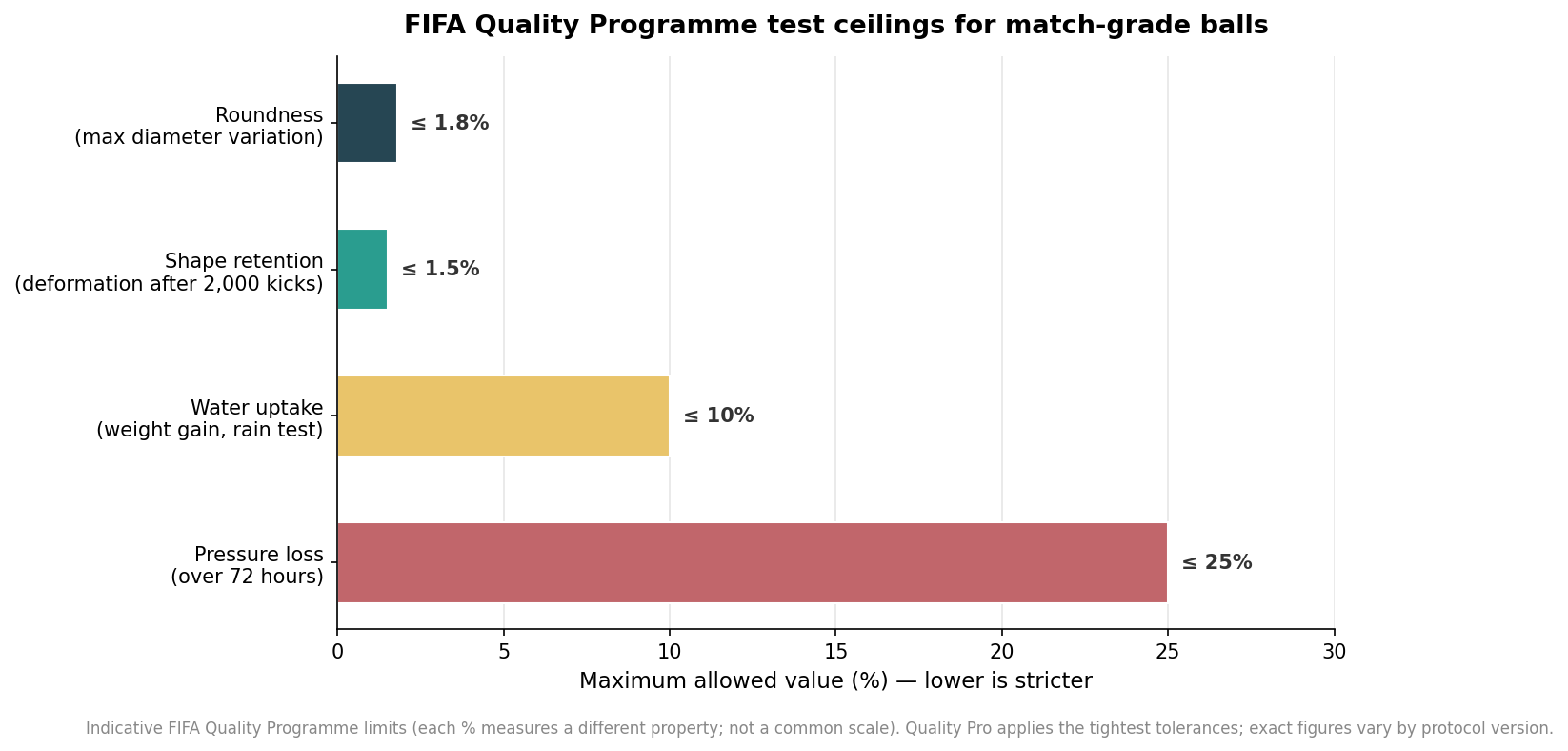
The numbers give you a feel for how tight the tolerances are. A match-grade ball generally has to hold roundness within about 1.8 percent variation between its largest and smallest diameter, rebound to a height inside a 125 to 155 cm band when dropped from two meters, gain no more than about 10 percent of its weight in a simulated rain test, deform no more than roughly 1.5 percent after 2,000 kicks against a steel plate, and lose no more than about 25 percent of its internal pressure over 72 hours. These figures are indicative of the FIFA Quality Programme rather than exact for every protocol version, and the Quality Pro tier applies the tightest end of each range.
Basic, Quality, and Quality Pro: what separates the tiers
FIFA Basic is the entry stamp. It confirms a ball meets fundamental size, weight, and safety requirements and is suitable for training and recreational play. If you are ordering balls as branded giveaways, club fundraisers, or casual kickabout stock, Basic-level construction is usually all the performance you are paying to use.
FIFA Quality sits in the middle. It clears the same categories of test as the top tier but at slightly more forgiving thresholds, which suits club-level and semi-professional matches where the ball needs to behave predictably week after week without the price of an elite match ball. This is the sweet spot for most organized amateur leagues.
FIFA Quality Pro is the elite mark, applied to balls destined for professional and international competition. It demands the tightest tolerances on roundness, rebound consistency, and water uptake, and it is where thermally bonded panel construction earns its keep, because bonded seams take on far less water and hold their shape better than stitched ones. The performance gain is real, but so is the cost, and it is wasted on a ball that will mostly sit in a promotional gift bag.
Where IMS fits in
You will still see IMS, the International Match Standard, on plenty of balls. It predates the current FIFA tier names and runs a similar suite of tests at slightly more flexible thresholds, which positions it as a mid-tier option for domestic leagues, youth competition, and retail training ranges. Practically speaking, an IMS ball lands close to FIFA Quality in performance. If a competition specifies FIFA Quality or Quality Pro in its rules, IMS will not satisfy that requirement, so always check the sanctioning body’s wording before you commit a large order to it.
The specs your custom ball still has to hit
No quality mark changes the underlying dimensions set out in Law 2 of the Laws of the Game, and those dimensions are keyed to ball size, not to the certification tier. A size 5 ball, used from roughly under-14 up through the adult game, has to fall between 68 and 70 cm in circumference and weigh 410 to 450 g at the start of play, inflated to somewhere between 0.6 and 1.1 bar, which is about 8.5 to 15.6 PSI at sea level. Size 4, for the under-9 to under-13 band, runs 63.5 to 66 cm, and size 3, for the youngest players, sits around 58 to 60 cm and 300 to 320 g.
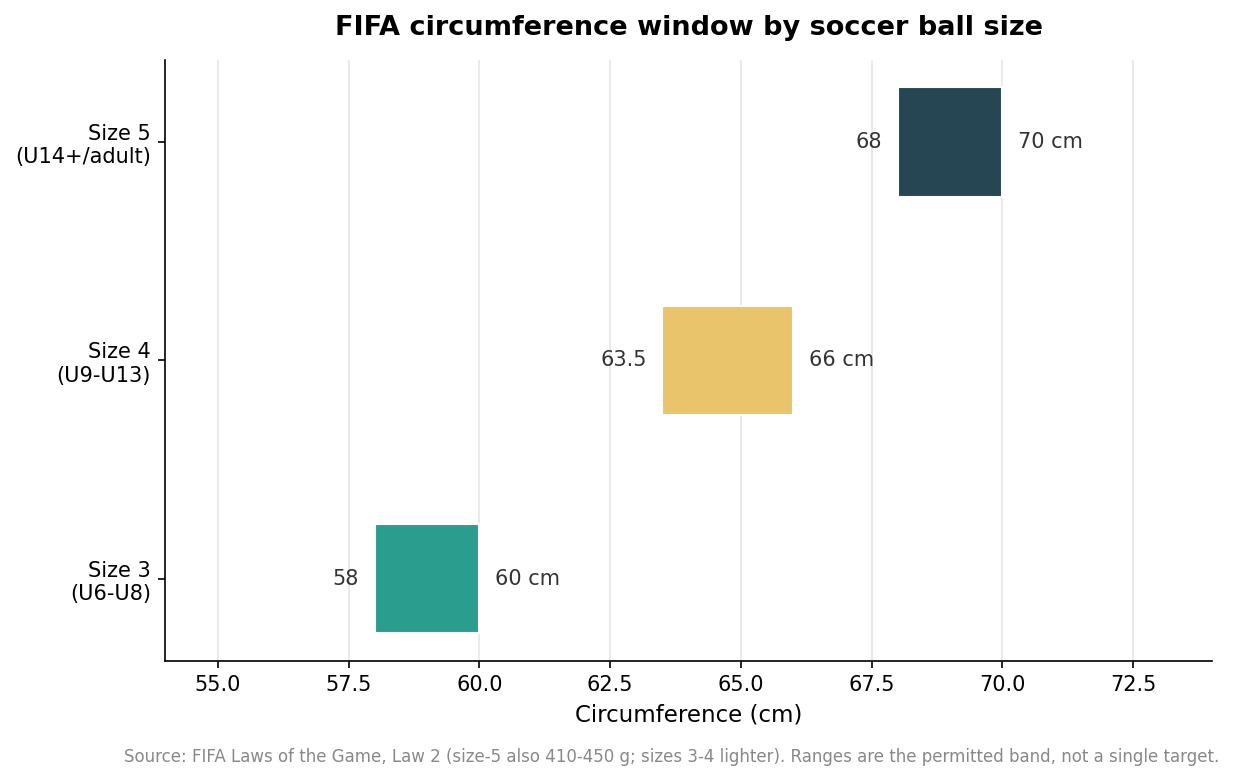
Two points matter when you specify a custom order. First, these are permitted ranges, not single targets, so ask your supplier where in the band their product actually lands, because a ball at the heavy end of size 5 feels different underfoot from one at the light end. Second, printing and construction can nudge a ball toward the edge of a tolerance, so a heavily decorated promotional ball is not automatically match legal even if the base model was. If competition use matters, confirm the finished, printed ball still carries the mark.
Which mark should you order?
Work backward from how the ball will be used. For brand awareness, event swag, or youth practice where the ball will take gentle use and spend most of its life being kicked around a yard, a FIFA Basic or uncertified promotional ball keeps the unit cost low and still takes a logo cleanly. For a club that plays scheduled fixtures on grass, FIFA Quality or IMS gives you consistent flight and shape retention across a season without paying elite prices. Reserve FIFA Quality Pro for showcase matches, tournament final balls, or any fixture governed by rules that name it explicitly.
One more practical filter: decide how many you need and how long they have to last. A single ceremonial match ball justifies Quality Pro; a hundred balls for a summer camp almost never does. Match the certification to the job and the budget follows naturally, rather than paying for lab performance that never leaves the equipment bag. When you request a proof, ask the supplier to confirm in writing which mark the finished, printed ball will carry, since that is the detail a referee or league official will actually check.
Create your custom soccer balls now.
Send your logo, quantity and date — you’ll get a free mockup and quote today.
Get a QuoteWin Free Stuff
Enter below for a chance to win plus receive 10% off your first order.
🎉 You are in!
Check your email for your 10% off code. Good luck!