Category: Uncategorized

  • The Spec Mistakes That Sink a Custom Soccer Ball Order

    The Spec Mistakes That Sink a Custom Soccer Ball Order

    When a custom soccer ball order disappoints, the artwork is almost never the culprit. The logo prints fine. What goes wrong sits underneath the design: a bladder that cannot hold air on a shelf, a cover chosen on price that cracks in the cold, a ball ordered off official dimensions, or a panel layout that fights the print. These are spec decisions, and they are easy to get right once you know what each one controls. Here are the mistakes buyers make most, and how to avoid them.

    Buying for the wrong use

    The first mistake is treating a soccer ball as one product when it is really three. A match ball is built to perform and certify, a training ball is built to survive daily abuse, and a promotional or gift ball is built to look good and hit a price. Order a thin promo ball for a club’s training sessions and it will not last a season; order a premium match ball for a giveaway and you have overspent by a wide margin. Decide the real use first, because it dictates every other spec below, from the cover material to the number of backing layers laminated under it. Matching the ball to the job is the single decision that prevents the most expensive regrets.

    Ignoring the bladder

    The bladder is the part buyers forget and then blame. It is the internal air chamber, and its material decides how long the ball stays inflated. A latex bladder gives the softest, liveliest touch, which is why professional match balls use it, but it is porous enough that the ball noticeably softens after just one or two days and needs regular re-pumping. A butyl bladder trades a little of that feel for dramatically better air retention, holding pressure for weeks or even months. Synthetic rubber sits in between.
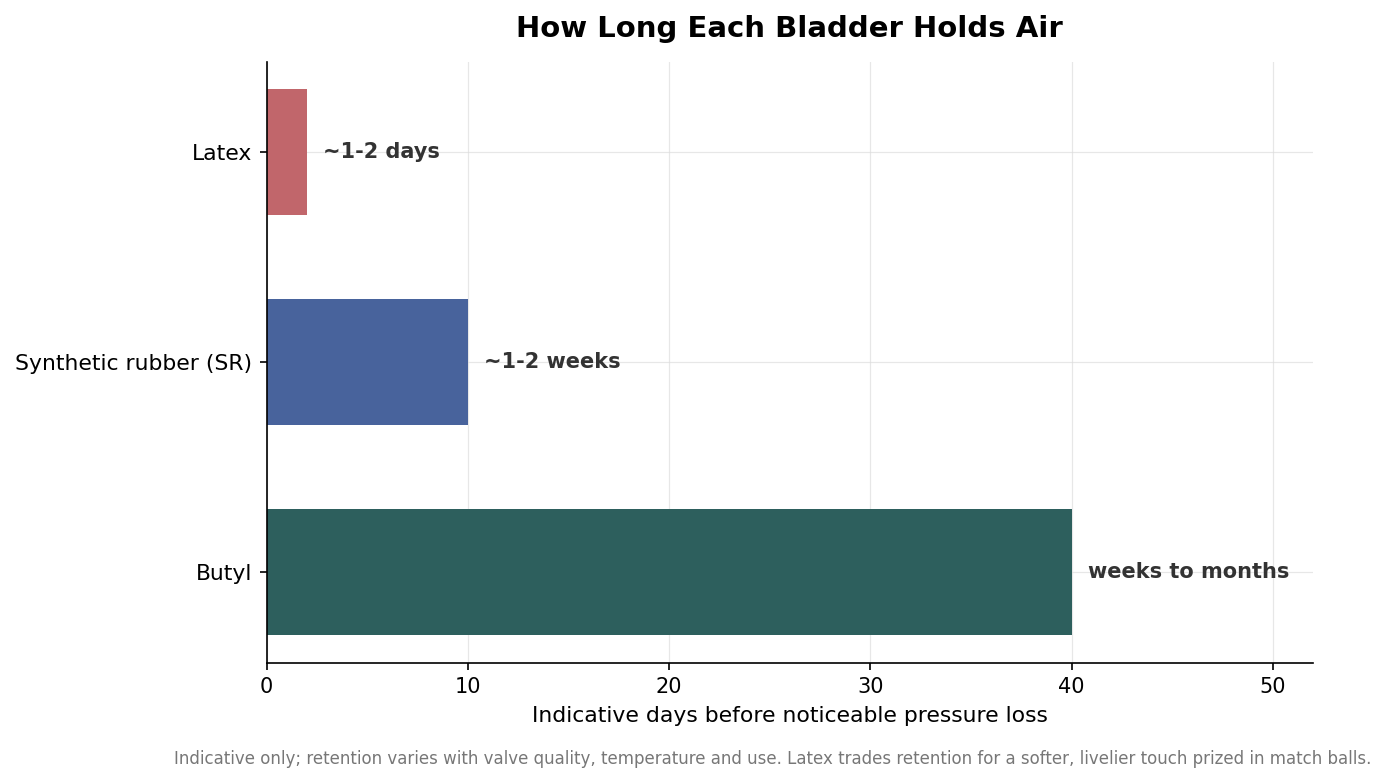
    Bar chart of indicative soccer ball bladder air retention: latex 1-2 days, synthetic rubber 1-2 weeks, butyl weeks to months
    How long each bladder type tends to hold inflation; latex gives the best feel but the shortest retention.

    The reason this matters for custom orders is shelf life. A promotional ball that sits in a box for a month before an event should almost always be butyl, because a latex promo ball will arrive flat and read as cheap no matter how good the print looks. Reserve latex for balls that will be inflated and played immediately by people who value the touch. Getting this one wrong is why so many giveaway balls disappoint on arrival.

    Choosing the cover on price alone

    The cover is the outer surface, and its material is a genuine cost-versus-durability tradeoff rather than a simple better-or-worse choice. PVC is the budget option: inexpensive and serviceable, but harder to the touch and prone to stiffening and cracking in cold weather, which makes it best for promotional and gift balls that will not see hard year-round play. PU is the premium surface, softer and more responsive with better wear resistance, and it is what match and serious club-training balls use. TPU lands in the middle, offering much of PU’s durability and cold tolerance at a lower price, which makes it a strong pick for training and junior match balls.
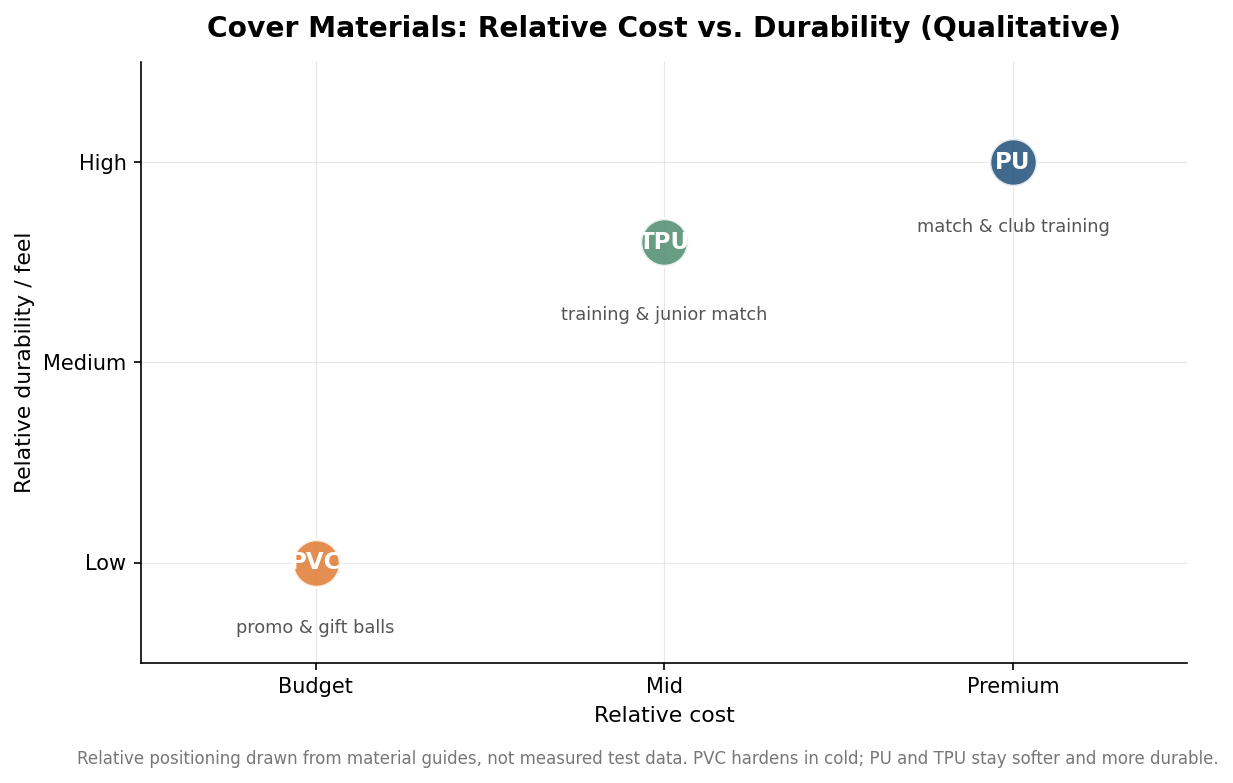
    Scatter plot positioning soccer ball cover materials by relative cost and durability: PVC budget/low, TPU mid, PU premium/high
    A qualitative map of cover materials by cost and durability, with the use each one fits best.

    The mistake is defaulting to PVC to hit a headline price without asking where and when the ball will be used. If it is a winter club or an outdoor program, PVC’s cold-weather stiffness will show quickly, and the small savings per ball turn into replacements. If it is a summer handout, PVC is perfectly reasonable. Spend where the use demands it and save where it does not.

    Ordering off official spec

    A custom ball meant for actual play has dimensions it must meet, and skipping them produces a ball that looks right but plays wrong. A regulation size 5 ball, the adult standard, measures 68 to 70 centimeters in circumference, about 27 to 28 inches, weighs 410 to 450 grams or roughly 14 to 16 ounces, and inflates to between 0.6 and 1.1 atmospheres, which is about 8.5 to 16 psi. Youth sizes step down from there, with size 4 and size 3 for younger age groups. Some very cheap promotional balls quietly come in under weight or under size; that is fine for a display piece but disqualifying for anything that will be kicked competitively. Confirm the finished size and weight in the spec, not just the diameter of the artwork template, and match the size to the age group that will actually use it.

    Designing artwork without the panels in mind

    The last common mistake is designing the graphic as if the ball were a smooth sphere. It is not; it is an assembly of panels, and how those panels are cut and joined shapes what the print can do. A traditional 32-panel stitched ball has visible seams that run through any large logo or photo, so fine detail and continuous background art can break across the stitching. Modern thermally bonded balls with fewer, larger panels present a smoother, more continuous surface that flatters full-coverage designs, though they usually carry higher minimums and cost. Print method matters too: sublimation lays full-color art into the panel before assembly and holds up well, while surface printing can wear at high-contact areas. The fix is simple but easy to skip: design to the actual panel layout and print process your ball uses, keep critical elements clear of seams, and ask for a panel-accurate proof rather than a flat mockup before you approve the run. Taken together, these five checks cost nothing to run through before you order, and each one closes off a failure that only shows up after the balls arrive, when it is too late and too expensive to fix.
  • What PSI Should a Soccer Ball Be? Official Pressure and How to Inflate

    What PSI Should a Soccer Ball Be? Official Pressure and How to Inflate

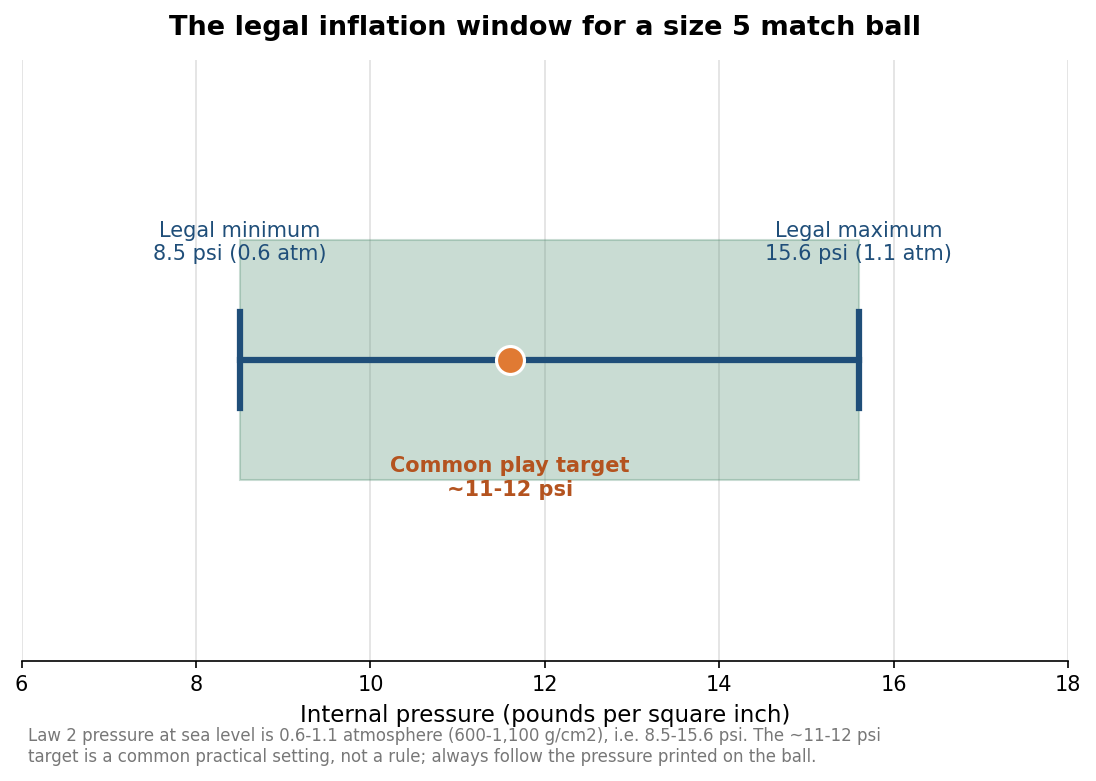
    A size 5 soccer ball is legal to play with anywhere from 8.5 to 15.6 pounds per square inch, and most balls play best somewhere in the middle of that band, around 11 to 12 psi. That single range answers the question most people arrive with, but it hides a few things worth understanding if you are buying, branding, or simply trying to keep a ball feeling right: where the number comes from, what happens when you stray from it, how to inflate without wrecking the valve, and why two balls at the same pressure can lose their air at very different rates.

    What the official spec actually says

    The pressure figure is set by Law 2 of the Laws of the Game, which defines every dimension of a match ball. A size 5 ball must be spherical, made of a suitable material, with a circumference between 68 and 70 centimeters (27 to 28 inches) and a weight between 410 and 450 grams (14 to 16 ounces) at the start of the match. Its internal pressure at sea level must equal 0.6 to 1.1 atmosphere, which the law also expresses as 600 to 1,100 grams per square centimeter, or 8.5 to 15.6 pounds per square inch.

    Those are the boundaries a referee can check, not a single target. The weight is specified at the start of play because a ball picks up water and mud during a match and drifts heavier, and the pressure is fixed at sea level because altitude changes the reading. For custom and promotional balls the same physical spec applies if you want the ball to play like a real one, which is why reputable manufacturers print a recommended pressure directly on the panel near the valve.

    Number line showing the legal inflation window for a size 5 soccer ball from 8.5 to 15.6 psi with a common play target near 11 to 12 psi
    Law 2 allows 8.5-15.6 psi (0.6-1.1 atmosphere) for a size 5 ball; around 11-12 psi is a common practical setting.

    Which pressure to actually use

    Always follow the number printed on the ball first. If the panel says inflate to 8.7 psi, that is the manufacturer’s tested setting and it takes priority over any general rule. Absent a printed figure, the safe practical target for a size 5 ball is roughly 11 to 12 psi — comfortably inside the legal window and firm enough for true flight without being rock hard.

    The reason the middle of the range is the sweet spot is that both extremes cost you something. Over-inflate toward 15 psi and the ball flies faster and truer but feels harsh off the foot, bounces unpredictably high, and puts more stress on the seams and bladder, shortening its life. Under-inflate toward 8 psi and the ball feels soft and dead, deforms on contact, curves less predictably, and drags on the ground. A ball that feels slightly soft under a firm thumb press — giving perhaps a centimeter — is usually close to right, but a cheap pressure gauge removes the guesswork and costs almost nothing.

    How to inflate without ruining the valve

    Most air-retention problems trace back to a valve damaged during inflation, so technique matters. Use a proper ball pump with a needle sized for soccer valves, and moisten the needle with a drop of water or a little glycerine before inserting it — a dry needle drags against the rubber valve and can tear it. Insert the needle straight in, not at an angle, so it does not gouge the valve channel, and hold the ball steady while you pump.

    Inflate slowly to the printed pressure and check with a gauge rather than by feel, then remove the needle gently. Avoid fully inflating a ball that is cold and stiff straight from a garage or a winter field; let it reach room temperature first, because cold rubber is less flexible and forcing air in can stress the seams. For storage, keep the ball partially inflated rather than bone hard or fully flat — a little internal pressure helps it hold its round shape without keeping the bladder and seams under constant maximum tension.

    Why some balls go flat faster

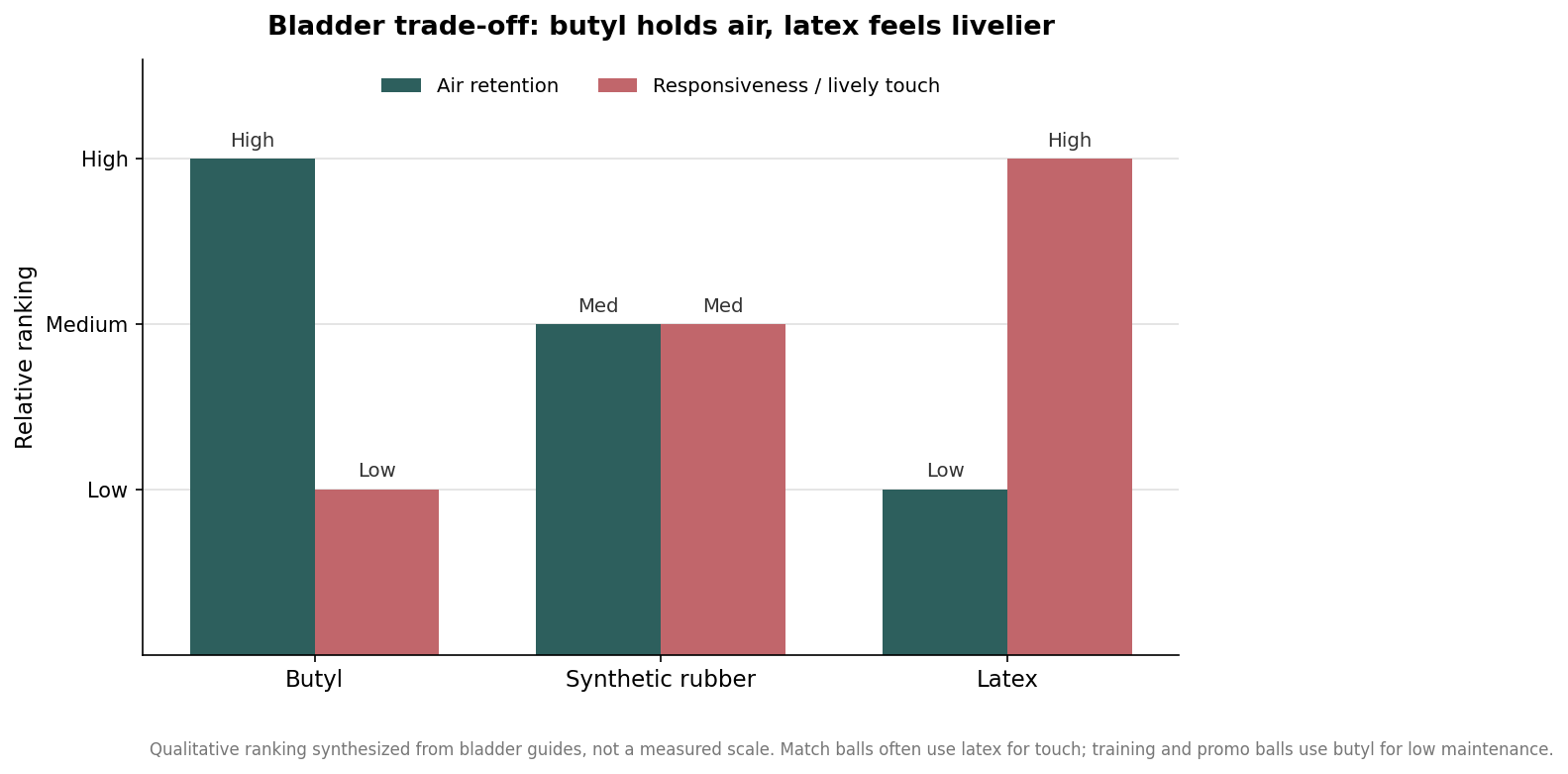
    Two balls inflated to the same pressure can behave completely differently over a week, and the reason is the bladder inside. A butyl bladder has an extremely tight molecular structure that holds air the longest, which is why it is the default for training and recreational balls and anywhere frequent re-inflation is impractical; the trade-off is a firmer, more controlled, slightly less lively feel. A latex bladder is the opposite: its looser structure leaks air faster and needs topping up more often, but it delivers the softest touch and the most responsive, explosive rebound, which is why premium match balls tend to use it. A synthetic rubber bladder sits in the middle, holding air better than latex while keeping a stable, consistent rebound, and it is common on school and college balls where predictability matters.

    Grouped bar chart ranking butyl, synthetic rubber, and latex soccer ball bladders on air retention versus responsiveness
    Butyl bladders hold air longest; latex feels livelier but needs topping up more often; synthetic rubber sits in between.

    None of this changes the legal pressure — every bladder type still plays within the same 8.5 to 15.6 psi window — but it changes your maintenance. A latex match ball may want a quick check before every session; a butyl training ball might hold usable pressure for a couple of weeks. Knowing which you have sets a realistic expectation instead of a nagging sense that the ball is defective.

    Matching the spec to a custom order

    If you are ordering branded balls, decide first how they will be used, because that dictates the construction more than the print does. A giveaway or photo-op ball can be a simpler, lower-cost build where perfect flight is not the point; a ball meant for real training should carry a durable butyl bladder and a stitched or bonded construction rated for repeated kicking; and a ball intended for competitive play should meet the full size 5 spec above and, ideally, carry a recognized quality mark. Whatever the tier, ask for the recommended inflation pressure to be printed on the ball, and confirm the circumference and weight targets in writing. Get the specification right at the order stage and the ball will play the way people expect the moment they pump it up — which, done correctly, means to the number on the panel and no higher.

  • Promotional, Training, or Match: Which Custom Soccer Ball to Order

    Promotional, Training, or Match: Which Custom Soccer Ball to Order

    Ordering custom soccer balls means choosing a tier before you choose a design. The same logo can go on a giveaway ball that costs a few dollars or a match ball that costs thirty times as much, and the two are not interchangeable. A ball built to be handed out at a sponsor booth will disappoint a club that wanted training gear, and a hand-stitched match ball is money wasted if it spends its life in a giveaway bin. This guide walks through the three tiers most custom programs choose among, what actually differs between them, and how to match the tier to the job before you approve artwork.

    What separates the three tiers

    Promotional balls are built around the print, not the play. They usually carry a PVC or thick TPU cover on a machine-stitched 32-panel body, prioritizing a smooth, uniform surface for logos and a low unit cost over touch and flight. They will kick around a backyard fine, but they feel firm and are not meant for organized play. Training balls step up to a tougher TPU or PU cover, still machine-stitched, with reinforced backing layers that survive daily drills on rough fields. Match balls use premium polyurethane covers that are hand-stitched or thermally bonded into a seamless surface, with water-resistant coatings and the tighter weight and roundness tolerances that sanctioned play demands. As you climb the tiers you are paying for feel, flight consistency, and durability under real use, in that order.

    Construction is where the tiers physically diverge. Machine stitching is fast and economical and holds up well, which is why it dominates promotional and training balls. Thermal bonding fuses panels without stitch holes, reducing water uptake and giving a truer surface, which is why it shows up on match balls and why those balls cost what they do. If a supplier quotes a “match ball” price that looks like a training ball, ask how the panels are joined before you assume you are getting match-ball performance.

    The bladder is the part buyers overlook

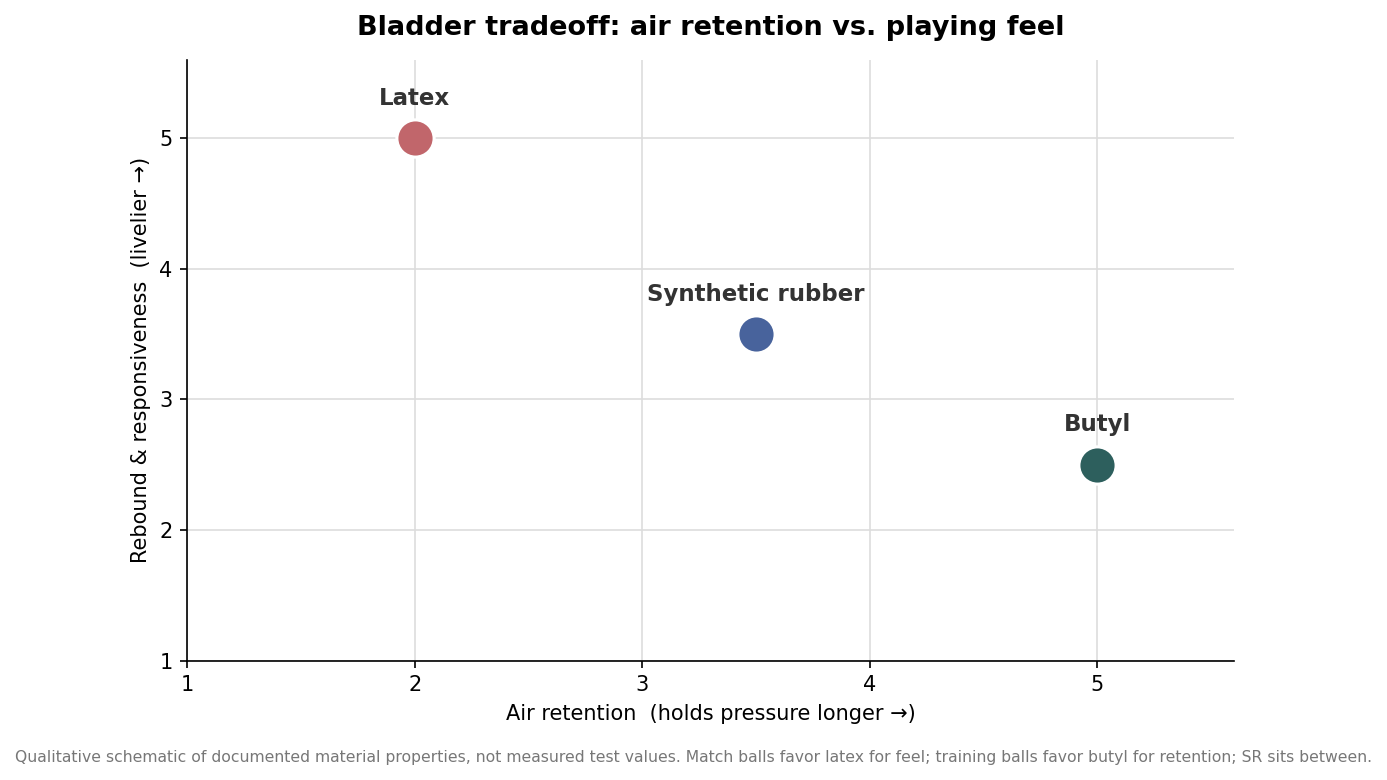
    Inside every ball is a bladder, and it drives two things buyers care about: how often the ball needs pumping and how lively it feels. Butyl bladders have very low gas permeability, so they hold pressure for a long time and suit schools, rec programs, and training stockpiles where nobody wants to reinflate a bin of balls every week. The tradeoff is a slightly damped, firmer response. Latex bladders flip that: they offer more elastic, explosive rebound and the softer touch players prize, but they lose air faster and need topping up before most sessions. Synthetic rubber sits in the middle, which is why it is common on balls that serve double duty for training and occasional matches.

    Scatter plot positioning butyl, synthetic rubber, and latex bladders by air retention versus rebound feel
    The bladder tradeoff: butyl holds air longest, latex feels liveliest, synthetic rubber sits between.

    The practical read on that tradeoff is simple. If the balls will be inflated and checked before every use by a coach or referee, latex rewards you with better feel, which is exactly why match balls use it. If the balls live in a closet or a school cart and get grabbed on the way to the field, butyl saves you the constant pumping. Ask which bladder a quoted ball uses; it tells you more about day-to-day experience than the marketing name on the box.

    What each tier costs, and where the money goes

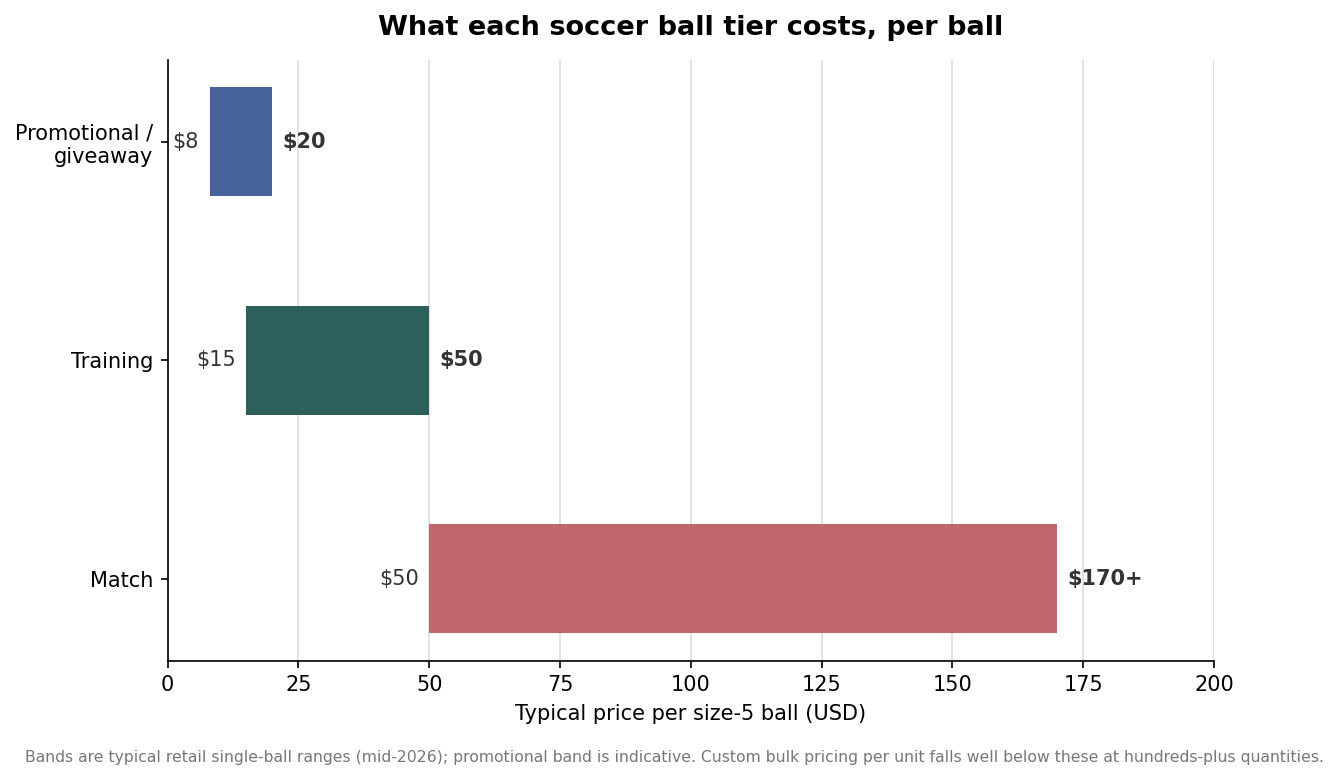
    Single-ball retail pricing gives a useful frame even when you buy in bulk. Promotional balls typically sell in a low band, training balls run roughly fifteen to fifty dollars, and match balls span fifty dollars to well past a hundred and seventy for flagship models. Your custom per-unit cost drops substantially at hundreds-plus quantities, but the tier gaps hold: a match ball will always cost multiples of a promotional ball because the cover, the stitching or bonding, and the tolerances cost more to produce.

    Horizontal range bars showing typical per-ball price bands for promotional, training, and match soccer balls
    Typical single-ball price bands by tier; custom bulk pricing per unit falls below these at larger quantities.

    Read the bands as a budgeting tool rather than a target. A youth club outfitting twenty teams with training balls is solving a very different math problem than a business ordering five hundred branded giveaways, and the right answer is rarely the most expensive ball you can afford. Overspending on match balls for casual use wastes money on performance nobody will notice; underspending on promotional balls for a competitive program buys gear that gets retired fast. Anchor the budget to how the balls will actually be used.

    Matching the tier to the job

    For giveaways, sponsorships, and brand awareness, the promotional ball is the correct choice precisely because it is cheap and prints cleanly. Nobody expects a trade-show ball to fly like a match ball, and spending up would only shrink the quantity you can hand out. For club and school training, the training ball is the workhorse: durable enough for daily abuse, forgiving on the budget across dozens of balls, and honest about its job. For match day, tryouts, and showcase events, the match ball earns its price through consistent flight and the certified weight and roundness that sanctioned games require. Many programs buy two tiers at once, training balls in volume and a smaller set of match balls for games, which is usually smarter than forcing one tier to do everything.

    Where certification matters, be specific. A size-5 ball for sanctioned play must fall within the governing-body window of roughly 68 to 70 centimeters in circumference, 410 to 450 grams in weight, and an inflation pressure near 0.6 to 1.1 atmospheres, and league play often requires a recognized quality mark. Promotional and training balls carry no such approval and should not be ordered for officiated matches. If your program plays sanctioned games, confirm the mark on the specific model, not the product line.

    Specifying a custom print without downgrading the ball

    Customization should ride on top of the tier you chose, not force a lower one. Full-surface sublimation and panel printing are available across tiers, but the process interacts with construction: bonded match balls take edge-to-edge graphics beautifully, while heavily stitched promotional balls print cleanly on panels with a little design allowance around the seams. Supply vector artwork, confirm the number of print colors or whether the design is full-color sublimated, and ask for a digital proof and, ideally, a single physical sample before a large run. Approving a proof on the actual tier you intend to buy is the last checkpoint that keeps the finished balls looking and playing the way you expected when you set the budget.

  • FIFA Quality Marks Explained: Basic, Quality, Quality Pro, and IMS for Custom Soccer Balls

    FIFA Quality Marks Explained: Basic, Quality, Quality Pro, and IMS for Custom Soccer Balls

    Call or Text us: (929) 605-4397
    Specs

    FIFA Quality Marks Explained: Basic, Quality, Quality Pro and IMS

    Order a batch of custom soccer balls and you will run straight into a wall of quality marks: FIFA Basic, FIFA Quality, FIFA Quality Pro, and the older IMS stamp. They are not marketing badges. Each one maps to a defined battery of laboratory tests, and the mark a ball carries tells you what it was actually built to survive. Picking the right tier is the difference between a promotional giveaway that looks the part and a match ball a referee will accept for competitive play.

    This guide explains what the marks certify, where the real gaps between tiers sit, and how to decide which grade your order needs before you approve a proof.

    What the FIFA marks actually certify

    A FIFA quality mark certifies performance and durability measured against a published protocol, not the look of the ball. Testing is done on production samples in accredited labs, and a ball has to clear roughly ten separate checks to earn a stamp. The headline tests cover roundness, weight, rebound consistency, water absorption, pressure retention, and shape retention after repeated impact.

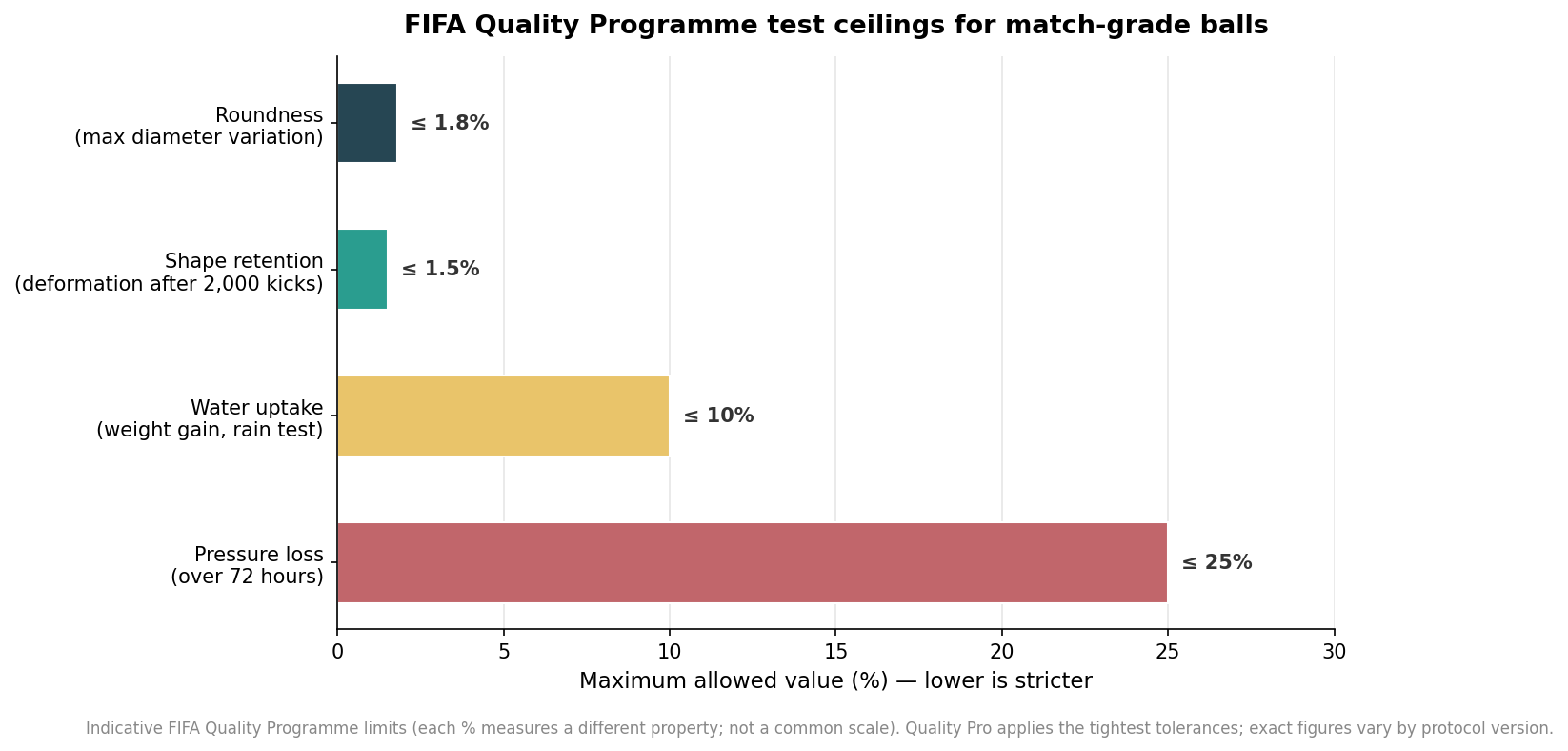
    The numbers give you a feel for how tight the tolerances are. A match-grade ball generally has to hold roundness within about 1.8 percent variation between its largest and smallest diameter, rebound to a height inside a 125 to 155 cm band when dropped from two meters, gain no more than about 10 percent of its weight in a simulated rain test, deform no more than roughly 1.5 percent after 2,000 kicks against a steel plate, and lose no more than about 25 percent of its internal pressure over 72 hours. These figures are indicative of the FIFA Quality Programme rather than exact for every protocol version, and the Quality Pro tier applies the tightest end of each range.

    Horizontal bar chart of FIFA Quality Programme percentage test ceilings for match-grade soccer balls
    Indicative FIFA test ceilings; each percentage measures a different property and Quality Pro uses the tightest tolerances.

    Basic, Quality, and Quality Pro: what separates the tiers

    FIFA Basic is the entry stamp. It confirms a ball meets fundamental size, weight, and safety requirements and is suitable for training and recreational play. If you are ordering balls as branded giveaways, club fundraisers, or casual kickabout stock, Basic-level construction is usually all the performance you are paying to use.

    FIFA Quality sits in the middle. It clears the same categories of test as the top tier but at slightly more forgiving thresholds, which suits club-level and semi-professional matches where the ball needs to behave predictably week after week without the price of an elite match ball. This is the sweet spot for most organized amateur leagues.

    FIFA Quality Pro is the elite mark, applied to balls destined for professional and international competition. It demands the tightest tolerances on roundness, rebound consistency, and water uptake, and it is where thermally bonded panel construction earns its keep, because bonded seams take on far less water and hold their shape better than stitched ones. The performance gain is real, but so is the cost, and it is wasted on a ball that will mostly sit in a promotional gift bag.

    Where IMS fits in

    You will still see IMS, the International Match Standard, on plenty of balls. It predates the current FIFA tier names and runs a similar suite of tests at slightly more flexible thresholds, which positions it as a mid-tier option for domestic leagues, youth competition, and retail training ranges. Practically speaking, an IMS ball lands close to FIFA Quality in performance. If a competition specifies FIFA Quality or Quality Pro in its rules, IMS will not satisfy that requirement, so always check the sanctioning body’s wording before you commit a large order to it.

    The specs your custom ball still has to hit

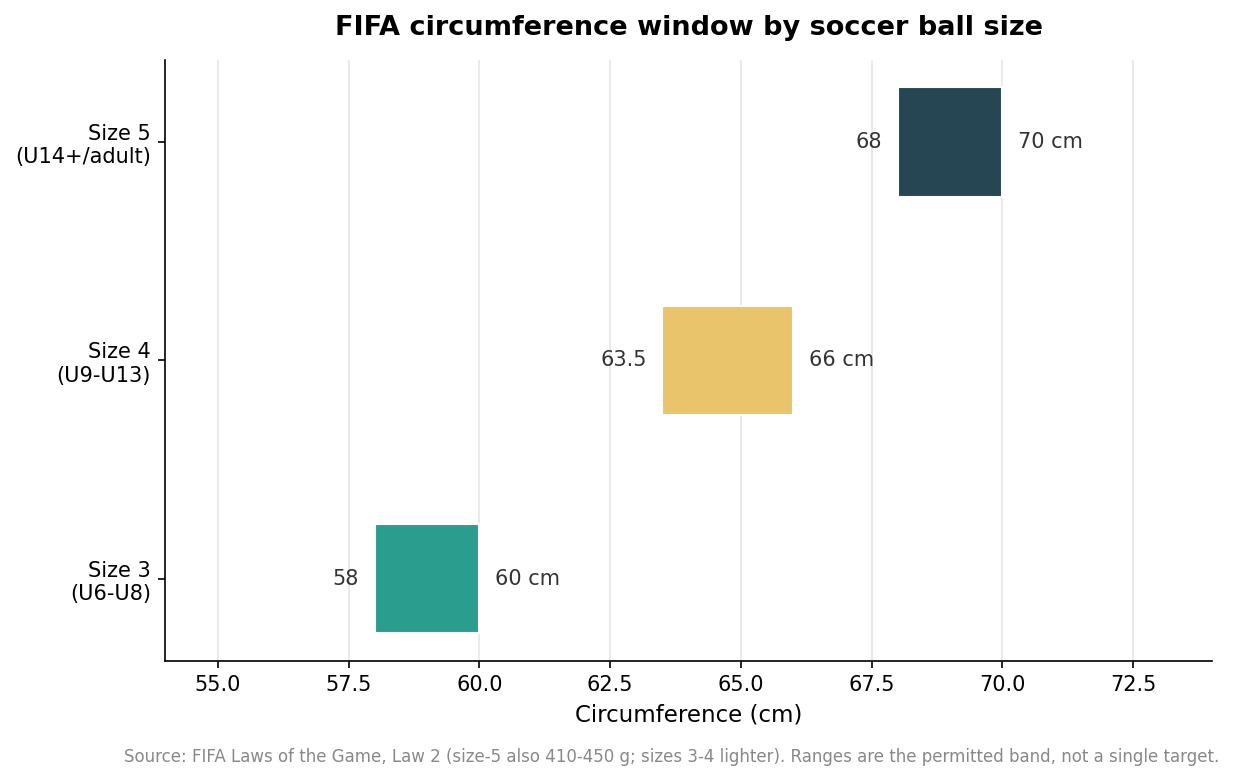
    No quality mark changes the underlying dimensions set out in Law 2 of the Laws of the Game, and those dimensions are keyed to ball size, not to the certification tier. A size 5 ball, used from roughly under-14 up through the adult game, has to fall between 68 and 70 cm in circumference and weigh 410 to 450 g at the start of play, inflated to somewhere between 0.6 and 1.1 bar, which is about 8.5 to 15.6 PSI at sea level. Size 4, for the under-9 to under-13 band, runs 63.5 to 66 cm, and size 3, for the youngest players, sits around 58 to 60 cm and 300 to 320 g.

    Range chart of FIFA circumference windows for size 3, 4, and 5 soccer balls in centimeters
    Ball dimensions are set by size under Law 2, independent of certification tier.

    Two points matter when you specify a custom order. First, these are permitted ranges, not single targets, so ask your supplier where in the band their product actually lands, because a ball at the heavy end of size 5 feels different underfoot from one at the light end. Second, printing and construction can nudge a ball toward the edge of a tolerance, so a heavily decorated promotional ball is not automatically match legal even if the base model was. If competition use matters, confirm the finished, printed ball still carries the mark.

    Which mark should you order?

    Work backward from how the ball will be used. For brand awareness, event swag, or youth practice where the ball will take gentle use and spend most of its life being kicked around a yard, a FIFA Basic or uncertified promotional ball keeps the unit cost low and still takes a logo cleanly. For a club that plays scheduled fixtures on grass, FIFA Quality or IMS gives you consistent flight and shape retention across a season without paying elite prices. Reserve FIFA Quality Pro for showcase matches, tournament final balls, or any fixture governed by rules that name it explicitly.

    One more practical filter: decide how many you need and how long they have to last. A single ceremonial match ball justifies Quality Pro; a hundred balls for a summer camp almost never does. Match the certification to the job and the budget follows naturally, rather than paying for lab performance that never leaves the equipment bag. When you request a proof, ask the supplier to confirm in writing which mark the finished, printed ball will carry, since that is the detail a referee or league official will actually check.

    Create your custom soccer balls now.

    Send your logo, quantity and date — you’ll get a free mockup and quote today.

    Get a Quote
    GET A QUOTE
  • Why a Branded Ball Beats Almost Any Other Club Merchandise

    Call or Text us: (929) 605-4397
    Business

    Why a Branded Ball Beats Almost Any Other Club Merchandise

    It is the only merchandise that gets used in public

    Clubs spend on scarves, keyrings and pin badges that sit in drawers. The ball is the one item that gets used in public, by children, in front of other children, every week.

    Sponsors understand a ball immediately

    Selling a sponsor a panel on the training balls is an easier conversation than selling them a page in a programme nobody reads. The ball is visible at every session, it photographs well, and the sponsor can see exactly what they are getting.

    It pays for equipment you were buying anyway

    This is the part clubs miss. You have to buy training balls regardless. Selling the panel space to a local sponsor can cover much of that cost, which turns a fixed expense into a funded one without asking parents for anything.

    Souvenir sizes fund themselves

    Mini balls with the crest sell at the gate all season. They cost a fraction of a match ball, they carry a crest better than almost anything else because the panels are small, and children actually want them.

    Specify it so the branding lasts

    Printing must go into the panels before the ball is assembled, never applied afterwards. Send your crest and sponsor artwork and we will lay it out across the panels on your mockup. Minimum order is 12 balls, production runs 2 weeks, and your free mockup arrives within 24 hours.

    Create your custom soccer balls now.

    Send your logo, quantity and date — you’ll get a free mockup and quote today.

    Get a Quote
    GET A QUOTE
  • Custom Soccer Balls: A Buyer’s Guide

    Call or Text us: (929) 605-4397
    Buyer’s guide

    Custom Soccer Balls: A Buyer’s Guide

    Buy two kinds of ball, not one expensive kind

    Most clubs buy one type of ball for everything, then wonder why it is unusable by November. The fix is not spending more, it is buying two different balls.

    A bonded match ball is built for consistent flight and does not cope well with being kicked against a wall five hundred times a week. A machine-stitched training ball is built for exactly that abuse. Using match balls for training is the single most expensive mistake in club equipment buying.

    Bonded or stitched comes down to water

    Stitching leaves channels, and channels let water in. A stitched ball gains noticeable weight through a wet match, which changes how it flies and how it feels to head. Heat-bonded panels have no channels at all. If your season is wet, that is the reason to pay for bonded, not the brand on the box.

    Get the sizes right for the age groups

    Size 5 for adults, size 4 for youth, size 3 for juniors. Buying one size for a whole club looks like a saving and is not: an oversized ball actively harms technique in young players, and undersized balls get abandoned.

    Printing goes in before assembly

    Ask any supplier when the artwork is applied. Printed into the panels before the ball is bonded means the branding is under the surface and lasts as long as the ball. Applied afterwards means it scuffs off, and a ball with half a crest left on it looks worse than a plain one.

    What to expect when you order

    Send your crest and the age groups you are buying for. You will get a free mockup within 24 hours, unlimited free revisions, and you pay nothing until you approve it. Minimum order is 12 balls and production runs 2 weeks, with faster turnaround available on express shipping.

    Create your custom soccer balls now.

    Send your logo, quantity and date — you’ll get a free mockup and quote today.

    Get a Quote
    GET A QUOTE
  • Bonded vs Stitched: Which Soccer Ball Construction Do You Need?

    Call or Text us: (929) 605-4397
    Specs

    Bonded vs Stitched: Which Soccer Ball Construction Do You Need?

    The seams decide the ball

    The seams are the only part of a soccer ball most buyers never look at, and they decide almost everything about how the ball performs and how long it lasts.

    How stitched balls work

    Panels are sewn together, either by machine or by hand. It is a proven, repairable, inexpensive construction, and machine-stitched balls are the right answer for training because the thicker casing they allow is what survives daily abrasion.

    Why the stitch channel matters

    Every stitch is a small hole through the outer casing. In dry conditions this is irrelevant. In rain the channels let water into the casing, the ball gains weight over the course of a match, and its flight and feel change while you are playing with it.

    How bonded balls solve it

    Heat and adhesive fuse the panels rather than sewing them, so there is no channel and effectively no water absorption. The result is a rounder ball with a more consistent flight that performs the same wet or dry — which is precisely why match balls are bonded.

    The practical split

    Bonded for fixtures and finals. Machine-stitched for everything else. Minimum order is 12 balls, production runs 2 weeks, and the mockup is free within 24 hours.

    Create your custom soccer balls now.

    Send your logo, quantity and date — you’ll get a free mockup and quote today.

    Get a Quote
    GET A QUOTE
  • Soccer Ball Size by Age: The Complete Size Chart (1 to 5)

    Soccer Ball Size by Age: The Complete Size Chart (1 to 5)

    Call or Text us: (929) 605-4397
    Buyer’s guide

    Soccer Ball Size by Age: The Complete Size Chart

    Buy the wrong size soccer ball and a five-year-old ends up wrestling a ball meant for an adult, or a competitive teenager trains with one that flies too light. Size is set by the player’s age, and the system runs from a tiny skills ball up to the full-size match ball the pros use. This guide gives the age-to-size answer first, then the actual specifications behind each size, the two ages where the choice gets fuzzy, and how to pick when you are ordering a batch of balls for a team or an event.

    The quick answer: size by age

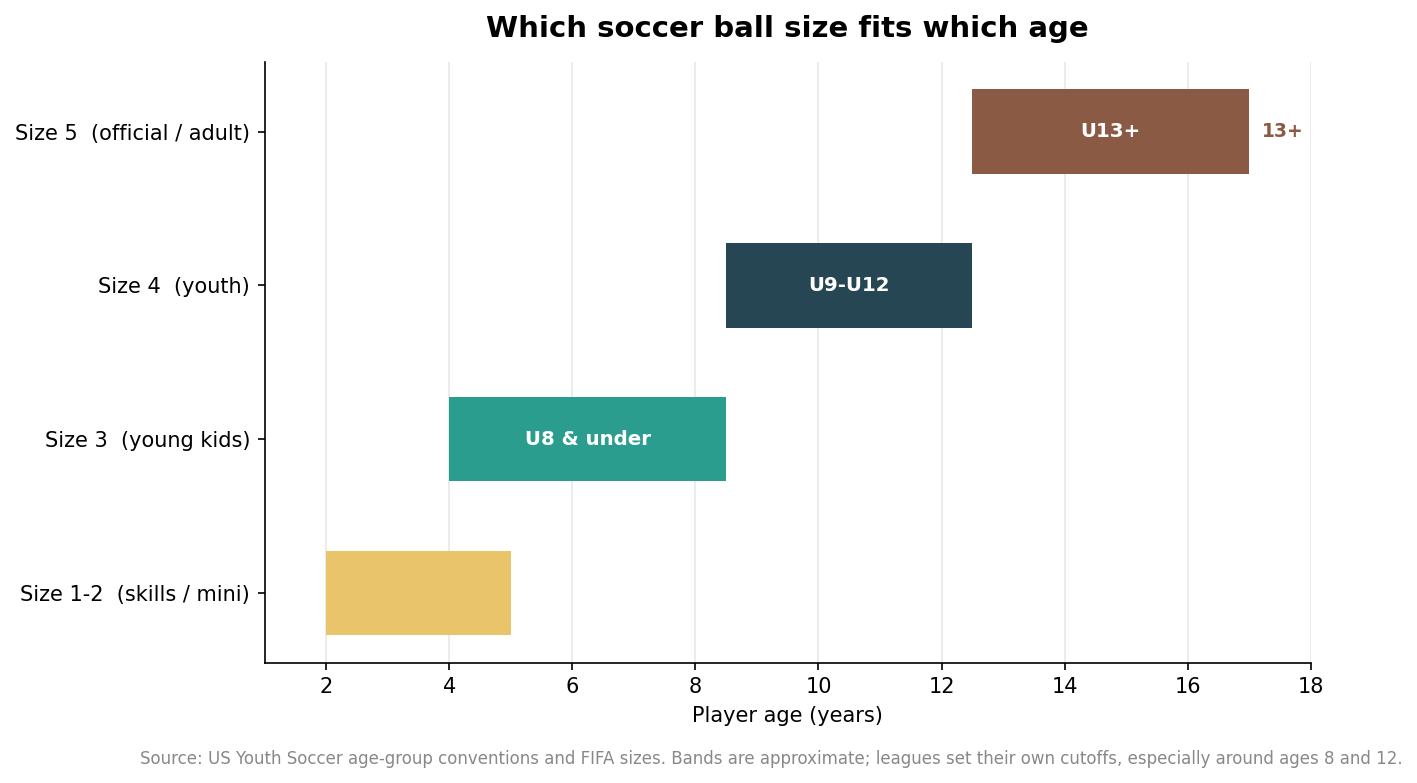
    Youth soccer uses three playing sizes tied to age. Size 3 is the ball for the youngest players, roughly age eight and under, the range most leagues label U8. Size 4 takes over for the middle years, about ages nine through twelve, or U9 through U12. Size 5 is the full-size official ball for players thirteen and older, which means every teenager, adult, and professional plays with the same size. Below all of that sit sizes 1 and 2, which are not really league balls at all but skills and mini balls, useful for toddlers and for footwork practice.

    Age-band chart mapping soccer ball sizes to player age: size 1-2 skills, size 3 for U8, size 4 for U9 to U12, size 5 for U13 and up
    The size-by-age map: three for the youngest, four for the middle years, five from the teens up.

    If you only remember one thing, remember the three cutoffs: three for the little ones, four for the in-between years, and five from the teens up. Those cover the vast majority of players and are the safe default when a league has not told you otherwise.

    What the sizes actually mean

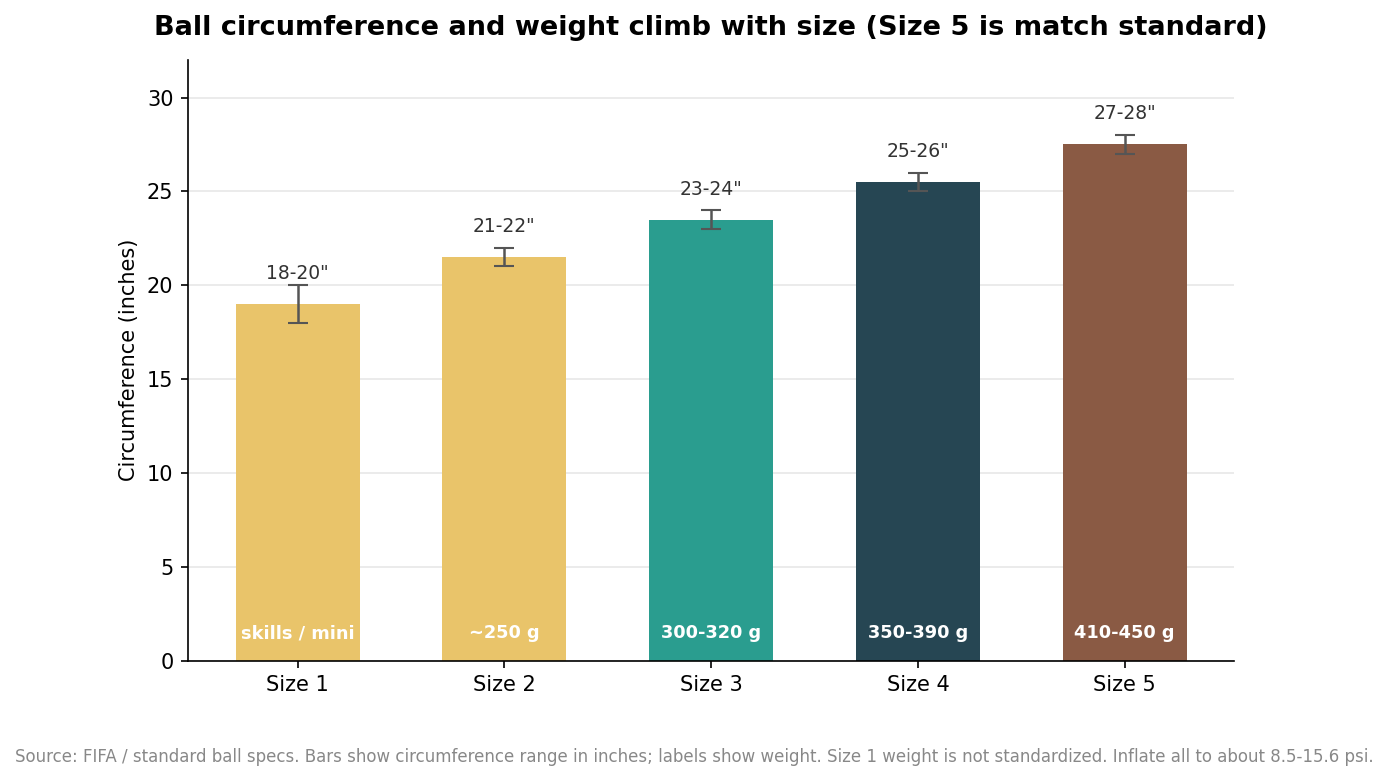
    The size number maps to a real circumference and weight, standardized so that a size 5 from one maker matches a size 5 from another. A size 5 measures about 27 to 28 inches around, roughly 68 to 70 centimeters, and weighs between 410 and 450 grams. A size 4 is a step down at about 25 to 26 inches, 63.5 to 66 centimeters, and 350 to 390 grams. A size 3 comes in around 23 to 24 inches, 58 to 61 centimeters, and 300 to 320 grams. The smaller sizes shrink from there, with size 2 near 21 to 22 inches and around 250 grams, and size 1 a mini ball of roughly 18 to 20 inches whose weight is not tightly standardized.

    Bar chart of soccer ball circumference in inches by size 1 to 5 with weight ranges labeled on each bar
    Circumference and weight both rise with size, from mini skills balls up to the size 5 match standard.

    Inflation matters as much as size. A properly inflated ball of any size sits in the range of about 8.5 to 15.6 psi, following the FIFA rule that a match ball hold between 0.6 and 1.1 atmosphere at sea level. Check the pressure printed near the valve, because an underinflated ball feels heavy and dead while an overinflated one gets hard and unpredictable. A cheap pump with a gauge pays for itself the first week.

    Choosing at the fuzzy edges

    Two ages cause almost all the confusion: eight and twelve. Around age eight a player is sitting on the line between size 3 and size 4, and different leagues draw it differently, some moving up at eight and others holding at size 3 through the season. Around age twelve the same thing happens between size 4 and the full-size 5, with some competitive programs introducing the size 5 a year early to prepare players for the jump. The rule that beats any chart is to check the specific league’s requirements first, because a mismatched ball can be a problem at organized games. When a child is between sizes or physically small for their age, sizing down for comfort and control is usually the better call for enjoyment and skill-building, even if the calendar says otherwise.

    Sizes 1 and 2: skills, minis, and giveaways

    The small sizes are easy to dismiss, but they earn their place. Size 1 is a mini ball, often used for close-control footwork drills where the reduced size forces cleaner touches, and it doubles as a keepsake or collectible. Size 2 is a toddler and training ball for the youngest kids just starting to kick. Because both are compact and inexpensive to produce, they are also the go-to for promotional and event balls, the kind handed out at a tournament, a school fundraiser, or a brand activation. If your goal is a memorable giveaway rather than league play, a printed size 1 travels and displays far better than a full-size ball.

    Ordering custom balls for a team or brand

    When you are buying more than one ball, size selection becomes a batch decision. For a single team, order every ball in the size that matches the squad’s age group so training and warmups stay consistent, and buy a few spares because balls wander off and lose air over a season. For a club spanning several age groups, plan the split up front: a stock of size 3 for the youngest teams, size 4 for the middle, and size 5 for the oldest and any adult sides. For a promotional run tied to an event or a brand, the mini size 1 or a size 2 usually gives the best mix of visual impact, shippability, and cost per unit, while a size 5 is the right choice when the recipients will actually play with it.

    Whatever the size, a custom ball is printed across its panels, so a bold, simple design with strong contrast reads better at a distance than fine detail that breaks up across the seams. Confirm the size against the intended age group before you commit the order, spell out the pressure range so recipients inflate to spec, and keep the color and logo consistent across the batch so a team or a campaign looks like a set. Get the size right and everything downstream, from how the ball plays to how it looks in a lineup, follows from that one choice.

    Create your custom soccer balls now.

    Send your logo, quantity and date — you’ll get a free mockup and quote today.

    Get a Quote
    GET A QUOTE